
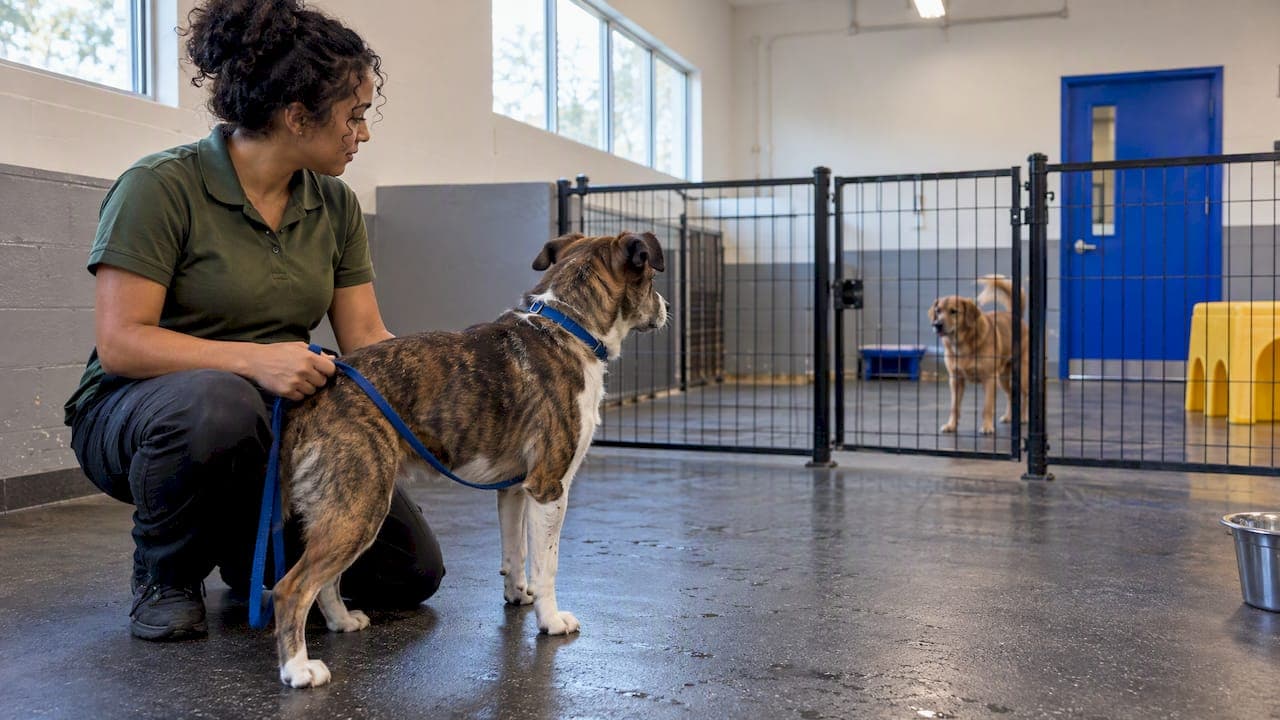
Some reactive dogs can do well in daycare. Others are happier with something quieter. The answer depends on your dog's triggers, how fast your dog recovers, and how the facility screens, staffs and separates its groups. This guide helps you sort out which category your dog is in, what to ask a daycare before you book, and what to do if group play is not the right fit.
TL;DR
- Reactive does not always mean aggressive. It means your dog overreacts to ordinary things like other dogs, people or leashes.
- Group daycare is not right for every reactive dog. Forcing it can make things worse.
- Look for a written screening, a gradual trial, trained staff who watch the dogs, and separate rest areas.
- Ask how the daycare handles reactive dogs and which behaviors end participation.
- If daycare is not a fit, walks, one calm playmate and training at home are good options.
Table of Contents
- What reactive actually means
- Can a reactive dog go to daycare?
- How to screen a daycare for a reactive dog
- What a good trial looks like
- How to prepare your dog
- Signs a dog is stressed
- Our view at Riverside
- What daycare costs at Riverside
- If group daycare is not the right fit
- Socialization without forcing it
- Questions to ask yourself before you book
- FAQ
- Sources
What reactive actually means
Reactivity is an exaggerated response to normal things in a dog's day. Cornell's veterinary college describes it as barking, lunging or growling at ordinary stimuli. The same page notes that reactive dogs are not necessarily aggressive, although reactivity can escalate into aggression when a dog becomes highly aroused.
That difference matters for daycare. A dog that barks and lunges on leash at the end of the street is not the same as a dog that bites. A dog that is fine one-on-one but overwhelmed in a crowd is not the same as a dog that is calm everywhere except around one type of trigger.
Before you call any daycare, write down what you know about your dog:
- Triggers. Other dogs, strangers, men in hats, bikes, doorbells, being approached while eating.
- Context. Does it happen on leash only? Behind a fence? Indoors? In a crowd?
- Intensity. Barking, stiffening, lunging, snapping, or biting?
- Recovery. How long does your dog take to settle after a trigger?
- Bite history. Be honest. Any good daycare will ask, and the answer decides which setup is safe.
Cornell also advises identifying the triggers and the context around them, then avoiding those triggers while you build a training plan. That list is the best thing you can hand to a daycare.
Can a reactive dog go to daycare?
Sometimes. It depends on the type of reactivity and on the daycare. Here is a rough guide. It is not a diagnosis, and a trainer or veterinary behaviorist who has met your dog can tell you more.
| Your dog's pattern | Group daycare outlook |
|---|---|
| Barks on leash, but relaxed and friendly off leash | Often possible with a careful trial |
| Nervous around new dogs, but warms up slowly | May work in a small, lower-energy group |
| Overexcited and pushy, lacks manners with other dogs | May do better with structure and short visits |
| Resource guarding of toys, food or people | Hard to manage in a group; ask about the facility's rules |
| Snaps or bites when handled | Group play is usually not safe; talk to a professional first |
| Intense fear or lunging at dogs and people | Look at walks, training and individual care first |
Preventive Vet lists the behaviors that can be hard to manage in daycare: resource guarding, handling sensitivity, shyness, nipping, excessive humping or barking, separation anxiety, and chasing driven by prey or herding instincts. If your dog shows several of these, be realistic. A daycare that says yes to every dog is not looking out for yours.
A good facility says no sometimes. That is a sign of good judgment, not a lack of welcome.
How to screen a daycare for a reactive dog
The screening matters more than the playroom. Use this checklist when you tour or call. Most of it comes from Preventive Vet's guide to choosing a daycare.
Screening and trial
- Is there a written behavior and health screening before the first day?
- Is there a temperament trial, and is it done gradually?
- What behaviors would end your dog's participation? Get this answer in plain words.
- How does the daycare handle reactive or noise-sensitive dogs specifically?
Staff and supervision
- Are trained staff actively watching the dogs, not just in the room?
- Do staff use positive-reinforcement handling?
- How many dogs does each staff member watch at once?
- How do staff step in when a dog starts to escalate?
Groups and space
- Are dogs grouped by size and temperament?
- Is there a rest area or a separate space where a dog can take a break?
- Is the fencing secure, and is there a double-door entry?
Health and communication
- What are the vaccination and illness rules?
- Is there a written process for incidents and injuries?
- How will staff tell you how your dog did after each visit?
If the person on the phone cannot answer these, or gets annoyed that you asked, keep looking. For reactive dogs, the details are the whole point.
What a good trial looks like
A trial should not be "drop your dog in the group and see." Preventive Vet says a daycare trial should gather your dog's health and behavior history, identify behaviors that would exclude a dog, watch how staff handle the dog, and introduce the dog gradually. The steps can go from a kennel beside the play area, to one-on-one meetings, to a lower-energy group.
That staged approach suits reactive dogs well, because it gives you data before your dog is in the middle of a crowd. Ask the staff how they judge whether your dog is enjoying the trial or needs a break. If they can describe what they look for in body language, that is a good sign.
Here is what a sensible first visit can look like:
- You share your dog's history, triggers and any past incidents, in writing if possible.
- Staff meet your dog and handle them, with you there at first.
- Your dog spends time near the play area without joining it.
- Staff introduce one calm dog at a time.
- If that goes well, your dog joins a small, relaxed group for a short stay.
- You get a clear report afterward, including what went well and what did not.
If any step goes badly, the right move is to stop and reassess. Pushing on to the next step is the wrong move.
How to prepare your dog
A few things you can do before the first visit:
- Tell the whole truth. Share triggers, bite history, medical issues and anything that sets your dog off. Staff can only protect your dog from what they know.
- Start with short visits. A few hours is easier than a full day. Many dogs do better with one or two days a week than with daily attendance, a point The Dog Atlas also makes about some fearful or dog-selective dogs.
- Keep your own energy calm. Dogs read their owners. A quick, relaxed drop-off helps more than a long goodbye.
- Watch your dog after pickup. A dog who comes home exhausted in a good way is different from a dog who is wired, hiding or wary the next day. Report what you see.
- Pause if needed. If your dog is more reactive after daycare than before, take a break and talk to a trainer.
Signs a dog is stressed
You will not always see a problem at drop-off. Ask staff to describe what they look at, and ask for honest reports. Things worth asking about include a dog that avoids the group, hides, stiffens, stares hard at other dogs, guards a spot or toy, or can't settle at the end of the day. A dog that is tired and calm at pickup, and relaxed at home that evening, is usually a good sign. Your own observations carry weight, so pass them on.

Our view at Riverside
At Riverside, we think about daycare for reactive dogs the same way we think about every dog: the dog comes first, and the group comes second.
We offer small play groups for daycare, and we start every new dog with a one-time evaluation. We do that because we do not want to guess. We want to see how a dog handles the space, the staff and the other dogs before we decide what is right for them.
The building matters too. Our kennels are large and climate controlled, with advanced air filtration, and we run a 24-hour security system. A calmer, cleaner space will not fix reactivity on its own, but it takes away a few things that can make a nervous dog worse.
Our honest advice for owners of reactive dogs is simple:
- Tell us everything about your dog before the evaluation.
- Expect us to be honest if group play is not the right choice.
- Do not treat daycare as a replacement for training. It can support the work you do with a trainer, but it cannot do the work for you.
Some dogs are happier with a different kind of day, and we would rather say so than put a dog in a situation that sets them back.
— Alexis
What daycare costs at Riverside
If you think your dog might be a fit, the first step is the evaluation. It is a one-time $20 fee. After that, daycare in small play groups is $32 per day. Prices are as published on our site, so check the page for current details.
The evaluation lets our staff meet your dog and see how they do before anyone commits to a schedule. You can also ask about the add-ons on our daycare page, including grooming on a daycare day.

Ready to start? Book a one-time evaluation through our dog daycare services page. If your dog needs overnight care as well, see our boarding options, where a Riverview walk is available for $10.
If group daycare is not the right fit
Not every reactive dog should be in a group, and that is fine. Cornell's guidance is to skip forcing it and look at other options, including training, individual walks or play, quiet sniff walks, one calm known playmate, and enrichment at home. The Dog Atlas also notes that some fearful, highly reactive or dog-selective dogs are happier with walks, enrichment or smaller play arrangements.
Some ideas to try:
- Quiet walks. Choose times and routes with few other dogs, and let your dog sniff.
- One calm playmate. A friend's dog that your dog already knows is a safer test than a room full of strangers.
- Puzzle feeders and chew toys. Mental work tires a dog out without any triggers.
- Short training sessions. Five minutes a few times a day beats one long, stressful session.
- A professional. A certified trainer or veterinary behaviorist can build a plan around your dog's exact triggers. If your dog has bitten or is getting worse, start there.
When you travel, ask about individual care. Our boarding uses large kennels, and you can talk to us about what your dog needs before you book on our boarding page.
Socialization without forcing it
Many owners feel guilty about a reactive dog that "needs to socialize." Socialization does not mean making your dog meet every dog. It means helping your dog feel safe around things that worry them.
Cornell describes avoidance as temporary management, not a fix. The longer-term approach is counter-conditioning: reward your dog as soon as the trigger appears, starting at a distance where your dog stays comfortable, then work closer over time. Cornell adds that consistent, frequent reward-based training can teach a dog to link triggers with good outcomes, until your dog looks to you for a treat when another dog shows up.
In practice:
- Find the distance where your dog notices a trigger but stays calm.
- Reward the moment your dog sees it.
- Move a little closer only when your dog stays relaxed.
- Back off right away if your dog tenses up.
- End each session on a good note.
This takes weeks or months. A trainer can help you set it up. Daycare can be one small piece of the plan, but only when your dog is ready for it.
Questions to ask yourself before you book
- Does my dog recover quickly after something upsets them?
- Has my dog ever hurt a person or another dog?
- Is my dog calmer with a few dogs or with many?
- Am I booking this for my dog's benefit, or for my own schedule?
- Am I willing to stop if it is not working?
If you have honest answers, you are in a good position to talk with a daycare and decide together.
FAQ
Can reactive dogs go to daycare?
Some can, especially dogs that are nervous or overexcited but not aggressive toward people or dogs. The facility should screen your dog, run a gradual trial and tell you honestly if group play is not safe. Dogs with a bite history or serious guarding need a professional's input first.
What should I tell a daycare about my reactive dog?
Share your dog's triggers, how your dog reacts, how fast they calm down, any bite or snap history, and any health issues. Staff can only manage what they know about. Being open also helps staff decide which group, if any, suits your dog.
What do you do with a reactive dog?
Start by finding the triggers and avoiding them while you train. Reward-based counter-conditioning, at a distance where your dog stays calm, is the approach Cornell's veterinary college recommends. For a dog that is getting worse or has bitten, see a certified trainer or veterinary behaviorist.
How much does dog daycare cost at Riverside?
Our small play group daycare is $32 per day, and the one-time evaluation is $20. Grooming and other add-ons are priced separately on our site. Check our daycare page for the current list.
Is it okay to do daycare only one or two days a week?
Yes. For some dogs, one or two days a week works better than daily attendance, as The Dog Atlas points out. It keeps the days shorter and less tiring, and gives you time to see how your dog does at home between visits.
Sources
- Managing reactive behavior, Cornell University College of Veterinary Medicine
- How to Choose a Dog Daycare, Preventive Vet
- Dog Daycare: How to Choose a Provider, The Dog Atlas