
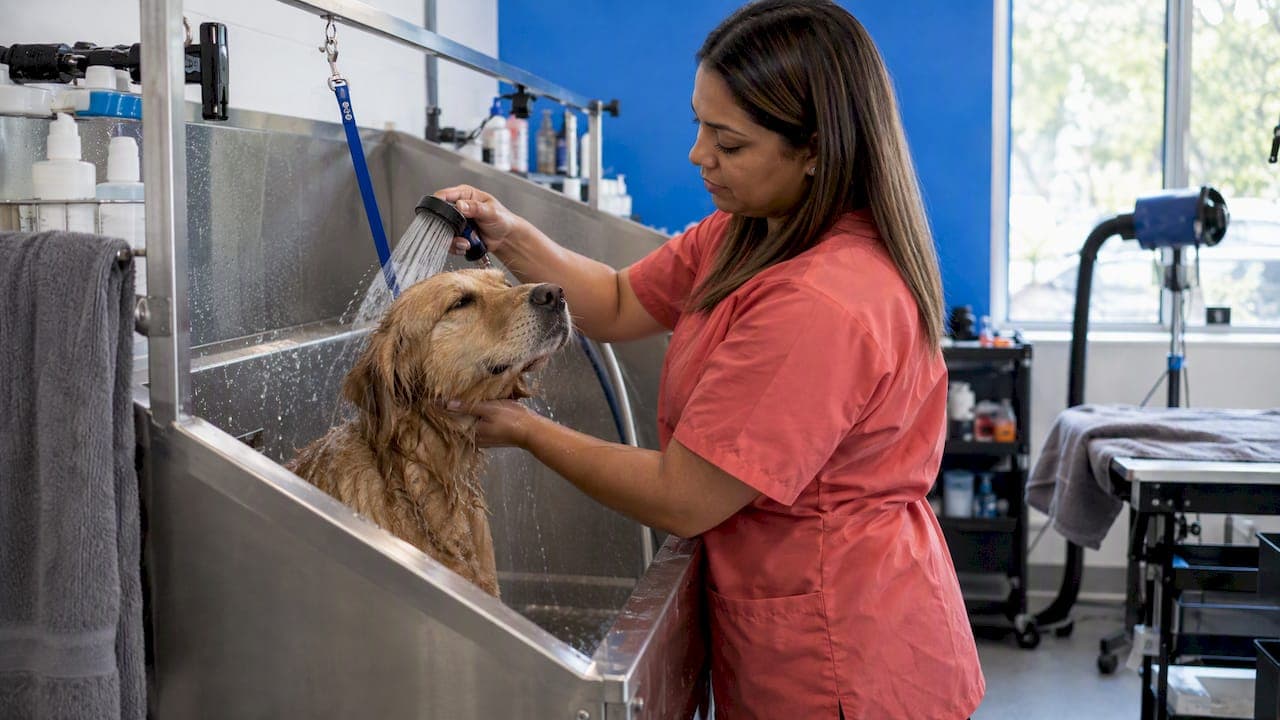
Gentle dog grooming means a dog is handled with patience, breaks and rewards instead of force. The dog gets to say "I need a minute," and the groomer listens. Veterinary groups describe this as cooperative care, and it is the standard to look for in any groomer. This guide explains what it looks like, how to prepare your dog, and how to groom gently at home. It also covers what to ask a groomer before you book, and what grooming costs at Riverside Pet Club & Resort in Central Pennsylvania.
TL;DR
- Gentle grooming relies on positive reinforcement, choice and predictability rather than restraint.
- Learn your dog's stress signals: lip licking, yawning when not tired, freezing, pulling away and showing the whites of the eyes. Pause when you see them.
- Start early, keep sessions short, and pair every new step with a treat your dog loves.
- Ask any groomer how they handle a nervous dog, what happens if your dog needs a break, and how they handle mats.
- Riverside offers baths, trims, nail care and more. See our grooming page for the full list and prices.
Table of Contents
- What gentle dog grooming actually involves
- Signs your dog is stressed during grooming
- How to prepare a dog for a calm grooming session
- Brushing and bathing gently at home
- Trimming nails and cleaning ears without the drama
- How often does your dog need grooming?
- What to look for in a gentle groomer
- Grooming at Riverside Pet Club & Resort
- Our perspective on gentle grooming
- FAQ
- Sources
What gentle dog grooming actually involves
Gentle grooming is not a special service with a special price tag. It is a way of working. The approach is called cooperative care. Dogs take part voluntarily in handling, and trainers use positive reinforcement, choice and predictability instead of force or restraint. Fear and anxiety are handled with desensitization and counterconditioning. In plain terms, the dog learns that the dryer, the brush and the clippers are not a threat.
This matches what veterinary groups ask of their own teams. The American Animal Hospital Association (AAHA) says in its 2015 behavior guidelines that veterinarians must avoid forced restraint and punitive methods. Those guidelines also oppose aversive techniques because they can cause problem behaviors. Groomers are not veterinarians, but the same logic applies. A dog that is scared once is harder to groom the next time.
A gentle session usually has these features:
- A calm start. The dog meets the groomer and the space before anything happens.
- Short, predictable steps. The dog knows what comes next because the order is always the same.
- Rewards along the way. Treats and praise come during the work, not only at the end.
- Breaks on request. If the dog shows stress, the groomer stops, gives space and tries a smaller step.
- Honest limits. A dog that cannot finish a full groom in one visit gets a shorter visit instead of a forced one.
Signs your dog is stressed during grooming
Dogs cannot tell us they are uncomfortable. They show it. Cornell's cooperative care guidance lists lip licking, yawning when not tired, freezing, pulling away and showing the whites of the eyes. If you see these, pause, offer a break, and plan smaller steps for the next session.
AAHA makes a related point about reading body language. Animals cannot give verbal consent, so staff read behavior to decide whether to go on. You can use that rule at home too.
A few practical notes:
- Stress often starts small. A dog that licks its lips at the sight of the brush is already telling you something.
- Stopping is not failure. A two-minute break early on prevents a bad memory that lasts for years.
- If your dog growls, snaps or tries to bolt, do not push through. Talk with your veterinarian or a qualified trainer, and tell your groomer before the visit.
How to prepare a dog for a calm grooming session
Preparation does most of the work. Cornell notes that handling skills are best learned in puppyhood or before a dog has a bad experience. Keep sessions short and predictable, and pair them with frequent rewards. Older dogs can still learn, but they need slower steps.
Five steps you can start this week
- Pick a high-value treat. Small pieces of something your dog loves, not everyday kibble.
- Touch, treat, stop. Touch a paw, an ear or the base of the tail for one second. Give a treat. Stop. Repeat for a minute or two.
- Work below the stress threshold. Cornell advises starting below your dog's stress threshold and pausing if signs of stress appear. Best Friends Animal Society says the same: move slowly and never push past the threshold.
- Add the tools one at a time. Show the brush. Treat. Touch the brush to the shoulder. Treat. Run it once along the back. Treat.
- Sit at an angle. During training, Best Friends suggests sitting at an angle instead of facing the dog, since a direct face-on posture can seem threatening.
The ASPCA gives a specific example for dogs that hate paw handling. It recommends daily leg and toe massage with praise and treats before any clipping, and says this may improve comfort within one or two weeks. That is a realistic timeline for many dogs, but yours may need longer.
Helping a fearful or sensitive dog
Counterconditioning is the core tool. You pair the thing your dog fears with something the dog loves, such as high-value food. Over time the dryer sound predicts chicken, not trouble. AAHA describes cooperative care as a positive reinforcement approach that lets animals take part voluntarily and reduces stress and fear.
If your dog is reactive around other dogs, a quiet one-on-one grooming visit may suit better than a busy day. Our post on reactive dog daycare explains how we think about group settings for sensitive dogs.

Brushing and bathing gently at home
Home care between professional visits keeps the coat healthy and makes salon visits easier.
Brushing. The American Kennel Club (AKC) advises brushing with gentle strokes down to the skin. It suggests bristle brushes for short, medium and some long coats, and slicker brushes to remove mats and dead hair. Work in short sessions. Reward your dog for standing still.
Bathing. AKC says to bathe regularly but not too often, because frequent bathing can strip natural oils. Use lukewarm water and a dog shampoo. Rinse well. Keep your voice low and your movements slow.
Mats. Small tangles can be worked out with a brush. Severe or extensive mats need a professional. VCA advises using clippers, never scissors, to remove mats, because scissors can cut skin that is pulled up into the mat. Dematting is also uncomfortable for the dog, so a short coat is sometimes the kinder choice. Ask your groomer for honest advice.
Trimming nails and cleaning ears without the drama
Nails and ears are the two jobs that worry owners most.
Nails
The ASPCA's steps are simple. Get the dog used to paw handling first. Then hold each toe firmly but gently, cut very small amounts at a slight angle, and stop when a nail-colored circle appears. Black nails need extra caution because the quick is harder to see. If you cut the quick, apply styptic powder or cornstarch with pressure. If bleeding lasts more than a few minutes, call your veterinarian.

A grinder is an alternative, but the ASPCA notes that noise and vibration may bother some dogs. Introduce it the same way you would any new tool: show it, treat, repeat.
Ears
Healthy ears usually need little. AKC says most dogs benefit from cleaning about once a month, though some need it more often. Clean only the visible outer ear with a damp cloth or a cotton ball lightly moistened with mineral oil. Never insert anything deep into the canal. Dry ears thoroughly after they get wet.
See your veterinarian for ear discharge, odor, redness, swelling, crusting, hair loss, scratching, head shaking or tilting, balance problems or unusual eye movements. The ASPCA lists these signs, and AKC adds that severe redness, debris or a strong yeasty smell may point to infection. Veterinary researchers also note that the right cleaner and technique matter when managing recurrent ear disease, so follow your vet's advice if your dog has a history of ear trouble.
How often does your dog need grooming?
There is no single schedule. It depends on coat, lifestyle and skin. Rover's coat guide puts the range from monthly baths for double and curly coats to every 6 to 12 weeks for some short-haired breeds. Long-coated breeds often need brushing daily, while short coats need it less often.
AKC's expert guidance says hairless breeds may need weekly baths, and medium to large coats can range from weekly to every four to six weeks depending on maintenance between baths.
A rough planning table:
| Coat type | Typical bath rhythm | Brushing |
|---|---|---|
| Short coat | Every 6 to 12 weeks for some breeds | Less often |
| Double coat | About monthly | Regular, more during shedding |
| Curly coat | About monthly | Frequent, to prevent mats |
| Long coat | Varies by coat and lifestyle | Often daily |
| Hairless | As often as weekly | Skin care rather than brushing |
Use this as a starting point and ask your groomer or veterinarian to adjust it for your dog.
What to look for in a gentle groomer
A friendly website is not proof of a gentle process. Ask these questions before you book:
- How do you handle a nervous dog? Look for answers about breaks, treats and going slowly.
- What happens if my dog needs to stop? A good groomer has a plan. Finishing another day is a fine answer.
- Do you use restraints or anything that holds the dog in place? Be wary of anything that keeps a dog from moving away.
- How do you handle mats? The answer should involve clippers and honesty about what is comfortable for the dog.
- Can I do a short first visit? A bath or a nail trim alone is a low-pressure start.
- How do you keep dogs safe and comfortable while they wait? Look at the space, the temperature and who is watching.
A good groomer will welcome these questions. If the answers feel rushed, keep looking.
Grooming at Riverside Pet Club & Resort
Riverside is a dog resort in Central Pennsylvania offering boarding, daycare and professional grooming for dogs from the Harrisburg area. Our focus is safety, comfort and personalized care, and our facility has a 24-hour security system.
Here are current grooming prices as published on our grooming page:
| Service | Price |
|---|---|
| Bath | $47-$78 |
| Express Groom | $25 |
| Trim | From $12 |
| Specialty Cut | From $30 |
| Furminator/De-Shedding | $25 |
| Flea and Tick Bath | $25 |
| Dematting | $25 per half hour |
| Teeth Brushing | $15 |
| Nails/Ears | $15 |
| Nail Grinding | $15 |
| Anal Glands | $10 |
| Doggy Daycare with Grooming | $22 |
If your dog is boarding with us, you can add a bath that includes nails and ears for $47-$78. See the boarding page for details.
For a nervous dog, a good first step is a single, simple service such as nails and ears at $15, or a bath. Short and simple builds confidence faster than a full groom on day one.

Book a grooming visit
Ready to try a calm first grooming visit? Choose a service on our grooming page and tell us about your dog's temperament, coat and any past bad experiences. That helps us plan the visit around your dog.

If you also need daycare, our daycare page lists a one-time evaluation for $20, enrichment daycare play groups at $32 per day and a 1-day stay at $22 per day.
Our perspective on gentle grooming
We see grooming as part of overall care, not a separate chore. A dog that feels safe in a clean, comfortable space with attentive people is a dog that tolerates handling better. That is why our resort is built around large, climate-controlled kennels with advanced air filtration, and why safety and personalized care come first.
Our advice to owners is simple. Start small. Do not wait for a full groom to find out how your dog reacts. Book a short service, watch how your dog responds, and tell us what you see. Dogs who are comfortable with one small step are ready for the next. Dogs who are not need a slower plan, and that is fine.
Also, be honest about your dog. Mention fear, past incidents and sensitive spots when you book. The more we know, the better the visit goes for your dog and for you.
— Alexis
FAQ
What is gentle dog grooming?
It is grooming based on cooperative care. The dog is handled with patience, rewards and breaks instead of force. Veterinary guidance from Cornell describes it as positive reinforcement, choice and predictability.
Can a nervous or fearful dog be groomed?
Yes, with preparation. Start below your dog's stress threshold, pair each step with a favorite treat and stop if stress signs appear. Tell your groomer about your dog's fears before the visit. Book a short, simple service first.
How often should I bathe my dog?
It depends on coat and lifestyle. Some double and curly coats need a bath about monthly, while some short coats can go 6 to 12 weeks. Bathing too often can strip natural oils, so ask your groomer or veterinarian for a schedule that fits your dog.
When should I see a vet instead of a groomer?
See a veterinarian for ear discharge, odor, redness, swelling, head shaking or tilting, or balance problems. Bleeding from a nail that lasts more than a few minutes also needs a call to your vet. Severe mats need professional care and should not be cut out with scissors.
What does grooming cost at Riverside?
A bath is $47-$78, an express groom is $25, and nails and ears are $15. Trims start at $12 and specialty cuts start at $30. Check our grooming page for the full list.
Sources
- Grooming - Cooperative Care, Cornell University
- How to Help Dogs Tolerate Grooming and Vet Handling, Best Friends Animal Society
- Dog Grooming at Home: Brushing, Bathing, and Nail Care, AKC
- Dog Grooming at Home, AKC (ear care)
- How Often Should You Wash Your Dog? AKC
- Dog Grooming Tips, ASPCA
- Grooming and Coat Care for Your Dog, VCA Animal Hospitals
- 2015 AAHA Canine and Feline Behavior Management Guidelines
- A Look Inside Fear Free Practices, AAHA
- Less stress and better outcomes with cooperative care, AAHA
- Managing recurrent otitis externa in dogs, JAVMA
- How To Groom Your Dog: What Different Hair Types Need, Rover