
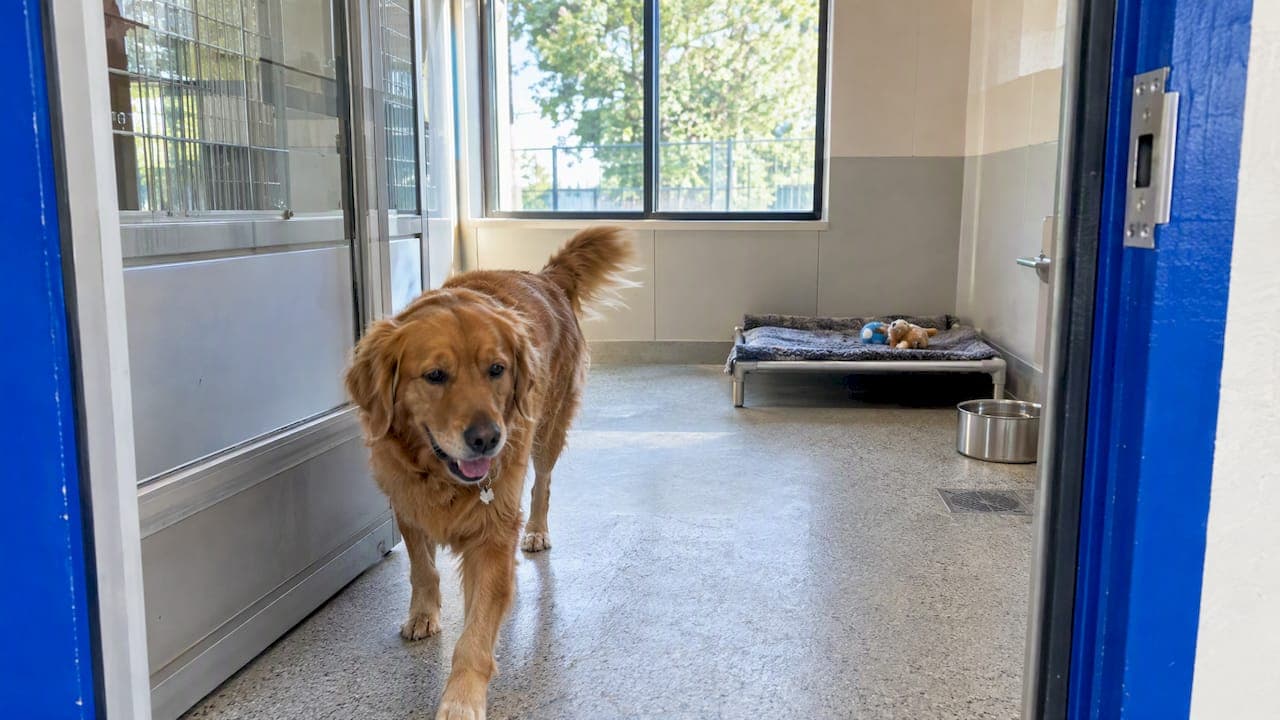
A climate controlled dog kennel keeps indoor temperature, humidity and airflow steady all year, so your dog is not stuck with summer heat, winter drafts or stale air. Good ones also filter and exchange the air, which matters when many dogs share one building. Below is what that means in practice, what the numbers should look like, and what to ask any boarding facility before you book.
TL;DR
- Climate control means more than an air conditioner. It covers heating, cooling, humidity, ventilation and filtration working together.
- Purdue's canine welfare researchers put dogs' comfortable range at 68°F to 86°F, with humidity between 30 and 70 percent.
- Federal rules for indoor dog housing set hard limits: no colder than 45°F and no hotter than 85°F for more than four straight hours.
- Poor air raises stress and the risk of respiratory illness like kennel cough. Ask how a facility handles airflow and filtration.
- At Riverside Pet Club & Resort, our large kennels are climate controlled and use advanced air filtration, backed by 24-hour security.
Table of Contents
- What "climate controlled" means for a dog kennel
- The temperature and humidity numbers that matter
- Why air quality matters as much as temperature
- Signs a kennel has an air problem
- Questions to ask before you book boarding or daycare
- What about heated and air conditioned dog houses?
- Perspective: why we built Riverside around the air
- What a stay looks like at Riverside Pet Club & Resort
- Book a tour or a stay
- Getting your dog ready for a comfortable stay
- FAQ
- Sources
What "climate controlled" means for a dog kennel
The phrase gets used loosely. Some people picture a heated dog house in a backyard. Others mean a boarding building with a full HVAC system. For a boarding or daycare stay, the second meaning is the one that counts.
A properly climate controlled kennel has four parts:
- Heating that holds the building above a safe minimum in winter.
- Cooling that keeps the space from getting too hot in summer.
- Humidity control, because damp air makes heat harder on a dog and encourages mold.
- Ventilation and filtration, which bring in fresh air and pull out dust, dander, odor and airborne germs.
Leave any one of these out and the kennel is only partly climate controlled. A cool room with no fresh air can still smell, feel stuffy and spread illness. A well-ventilated room with no heat is hard on a short-haired or senior dog in January.
In Central Pennsylvania the need is easy to see. We get humid summers and cold winters, and a kennel that is comfortable in October can be a problem in July or February. Steady conditions inside take that swing out of your dog's stay.
The temperature and humidity numbers that matter
You do not have to guess what "comfortable" means. There are published ranges, and they are worth knowing when you ask a facility questions.
What dogs find comfortable
Purdue University's canine welfare researchers describe a thermoneutral zone of 68°F to 86°F for dogs. Inside that band, a dog does not have to work to warm or cool itself. The same page recommends keeping indoor humidity between 30 and 70 percent. It adds that high humidity makes heat-related illness more likely and makes high temperatures feel hotter to a dog.

Those ranges are a guide, not a promise from any one facility. Breed, coat, age and health all change what feels right. A thick-coated husky and a thin-coated greyhound will not agree on a thermostat setting.
What federal rules require
Federal regulations for indoor dog housing, 9 CFR 3.2, set the floor and ceiling:
| Condition | Federal requirement |
|---|---|
| Minimum temperature | Not below 45°F for more than 4 consecutive hours |
| Minimum for sensitive or unacclimated dogs | Not below 50°F |
| Maximum temperature | Not above 85°F for more than 4 consecutive hours |
| Above 85°F | Auxiliary ventilation such as fans, blowers or air conditioning is required |
| Humidity | Never a combination of temperature and humidity that harms the dog |
The USDA's Animal Care tech note on dog temperature requirements explains that auxiliary ventilation above 85°F does not replace the duty to keep temperatures from staying that high. USDA also says dogs must never face a temperature and humidity combination that hurts their health, taking into account age, breed, health and acclimation.
Notice how wide the legal range is compared with the comfort range. Meeting the minimum is not the same as being comfortable. When you tour a facility, the better question is not "are you within the rules?" but "what temperature do you aim for, and who checks it?"
Why air quality matters as much as temperature
Temperature gets the attention, but air is what your dog breathes for the whole stay. Dogs in a shared building are in the same air, and that air carries dust, dander, odor, moisture and germs.
The American Kennel Club notes that poor ventilation, cold air and stress all raise a dog's susceptibility to infectious respiratory disease such as kennel cough, which spreads easily through airborne droplets in boarding and daycare spaces. Stress and air quality are linked: a noisy, stuffy, uncomfortable space is harder on a dog than a calm, fresh one.
This is why we treat air as part of care, not an extra. A dog that breathes easily, sleeps well and is not fighting heat or chill is a dog that can enjoy play groups and rest between them.
How ventilation and filtration work together
They do different jobs.
- Ventilation moves fresh outdoor air in. According to the NIH's standards of care guide for animal shelters, this dilutes odors, airborne microbes and gases such as ammonia and carbon monoxide, and carries off extra humidity.
- Filtration catches what is in the air. High-efficiency filters capture smaller particles such as dander and dust, which can carry microbes or irritate a dog's airways.
The same guide gives a general benchmark of 10 to 20 room air exchanges per hour for animal facilities. It also says dogs in isolation should have air circulation separate from the rest of the facility, so respiratory illness does not travel through shared air.
Filter quality is not a minor detail. A CDC study of animal-quarters air handling looked at replacing basic bag filters with higher-efficiency filters and measured how well each captured particles from submicron to larger sizes. The lesson for pet owners: "we have a filter" says little. Ask what kind, and how often it is changed.
Gases you cannot see
Two invisible problems deserve a question when you tour.
Ammonia. It builds up from urine in the air. Purdue's guidance says to test at dog nose level, routinely, with ammonia strips or a sensor, aiming for 10 ppm and never going above 25 ppm. Dogs live close to the floor, so a reading taken at head height for a person can understate what they breathe.

Carbon monoxide. Purdue also says kennels should have carbon monoxide detectors installed, because carbon monoxide poisoning can be fatal. It is odorless, so you cannot judge it by smell.
Signs a kennel has an air problem
You can learn a lot in a ten-minute tour. The NIH shelter guide lists signs that ventilation or filtration may not be doing its job:
- A lingering unpleasant odor, beyond the normal smell of dogs
- Visible mold or fungus on interior surfaces
- Dogs coughing, sneezing or showing respiratory irritation
- Stagnant or very humid air
- Heavy dust or visible dander on surfaces
Use your own senses too. Does the air feel fresh when you walk in? Is it too warm, too cold or damp? Do you smell ammonia? A well-run building smells clean, not perfumed. Strong air fresheners can hide a problem rather than solve it.
Also watch the dogs. Are they relaxed, or hot and panting? Are any coughing? Staff who welcome these questions are a good sign.
Questions to ask before you book boarding or daycare
Take this list on your tour or read it over the phone.
- What temperature range do you keep indoors, and how is it monitored? Look for a clear answer, not "it's comfortable."
- Is the whole building heated and cooled, or only some rooms? Play areas, sleeping kennels and any isolation space should all be covered.
- How do you handle humidity? In summer this matters as much as the air conditioning.
- What kind of air filtration do you use, and how often are filters checked or changed? Regular upkeep of HVAC systems, filters and vents is part of what makes them work.
- How is fresh air brought in? A sealed building with recycled air is different from one with managed ventilation.
- Do you have carbon monoxide detectors?
- Do you test air quality, such as ammonia levels?
- What happens if the power goes out or the system fails? Ask about backup plans and who is on site overnight.
- How do you separate a coughing or sick dog from the others?
- Who is in the building overnight, and is there security?
If you want a broader view of how a long stay works, our guide to extended stay dog boarding in Harrisburg covers what to pack and plan.

What about heated and air conditioned dog houses?
Search results for this topic are full of outdoor dog houses, crate air conditioners and heated shelters. Those products are built for a backyard or a single crate at home, and they solve a different problem: keeping one dog comfortable at your house.
Boarding is another situation. Your dog is indoors with other dogs, for hours or days, while you are away. Here the building's whole system matters: heating, cooling, humidity, fresh air, filtration and people watching over it. A single unit in a single crate cannot replace that.
If you are choosing a place for your dog to stay, judge the facility, not a gadget.
Perspective: why we built Riverside around the air
We started with a simple idea. A dog's stay should feel good for the whole day and night, not just during play. That begins with the space.
That is why our kennels are large and climate controlled, and why we use advanced air filtration. Our goal is a healthier environment than a standard kennel gives. Fresh, clean, comfortable air helps dogs rest, and rested dogs enjoy daycare and boarding more.
We also know you cannot see air from the lobby. So we think you should ask about it, and we are glad when you do. Tour with us, look at the kennels, and ask anything on the list above.
Safety is the other half. Our 24-hour security system is there so you can leave your dog with us and feel at ease. Comfortable air, a secure building and an attentive team: that is how we think boarding should work.
Alexis
What a stay looks like at Riverside Pet Club & Resort
We care for dogs from Harrisburg and across Dauphin County and Central Pennsylvania. Here is how the services fit together, with prices as published on our site.
Boarding
Boarding is listed at $45 to $50. Your dog stays in one of our large, climate-controlled kennels. Add-ons include a bath with nails and ears ($47 to $78) and a 10 to 15 minute Riverview walk ($10). You can also pair boarding with daycare play at $22 per day.
Daycare
Daycare gives your dog supervised social time. Enrichment daycare with play groups is $32 per day. A 1-day stay is $22 per day. New dogs start with a one-time evaluation for $20. If your dog is nervous around other dogs, read our piece on whether group play is right for a reactive dog.
Grooming
Grooming covers a full range, from a bath ($47 to $78) to a trim (from $12), specialty cut (from $30), de-shedding ($25), flea and tick bath ($25), teeth brushing ($15) and nails ($15). If your dog is anxious on the table, see what gentle dog grooming means.
Prices can change, so check each page for the current list.
Book a tour or a stay
The easiest way to judge a kennel's air is to stand in it. Come see our climate-controlled kennels, ask about our filtration, and meet the team. When you are ready, book boarding or start with a $20 daycare evaluation on our daycare page.

You can also explore everything we offer on the Riverside Pet Club & Resort home page.
Getting your dog ready for a comfortable stay
Even in a well-run building, a little preparation helps.
- Tell staff about your dog's coat and sensitivities. A senior dog, a short-coated dog or a dog with breathing trouble may need special attention. If your vet has advice for a health condition, share it with us.
- Pack familiar items. A blanket or toy that smells like home can help a dog settle.
- Check vaccines early. Respiratory illness spreads in shared spaces, and kennel cough is one reason facilities ask for up-to-date vaccines. Ask your veterinarian which ones your dog needs.
- Start with a short visit. A daycare evaluation or a one-day stay lets your dog get used to us before a longer boarding trip.
- Watch for a cough after any stay. If your dog coughs, sneezes or seems off after boarding anywhere, call your veterinarian and let the facility know.
FAQ
What temperature should a dog kennel be?
Purdue's canine welfare researchers describe 68°F to 86°F as dogs' thermoneutral zone. Federal rules for indoor dog housing set outer limits: not below 45°F, or 50°F for sensitive dogs, and not above 85°F for more than four consecutive hours. Ask any facility what range it aims for, since the legal limits are wider than the comfortable range.
What humidity is best in a dog kennel?
Purdue recommends keeping indoor humidity between 30 and 70 percent. High humidity makes heat harder on dogs and makes high temperatures feel hotter. That is why cooling alone is not enough in a Pennsylvania summer.
Does air filtration really help in a boarding facility?
High-efficiency filtration captures fine particles such as dust and dander that can carry microbes or irritate a dog's airways. It works best alongside fresh-air ventilation, which dilutes odors, gases and airborne germs. Ask what kind of filters a facility uses and how often they are maintained.
Can dogs catch kennel cough in a climate controlled kennel?
Any place where dogs share space has some risk, since kennel cough spreads through airborne droplets. Good ventilation, steady comfortable temperatures and low stress all help, as does keeping vaccines current. Talk to your veterinarian about what your dog needs before boarding or daycare.
Sources
- Environmental Sources of Stress for Kenneled Dogs: Temperature and Ventilation, Purdue Canine Welfare Science
- 9 CFR 3.2, Indoor housing facilities, eCFR
- Animal Care Tech Note: Temperature Requirements for Dogs, USDA APHIS
- Questions and Answers: Temperature and Humidity in Dog Facilities, USDA APHIS
- Standards of Care in Animal Shelters, NIH OACU
- What to Know About Kennel Cough in Dogs, American Kennel Club
- Real-Time HVAC Filter Efficiency Testing Using Optical Particle Counters, CDC Stacks