
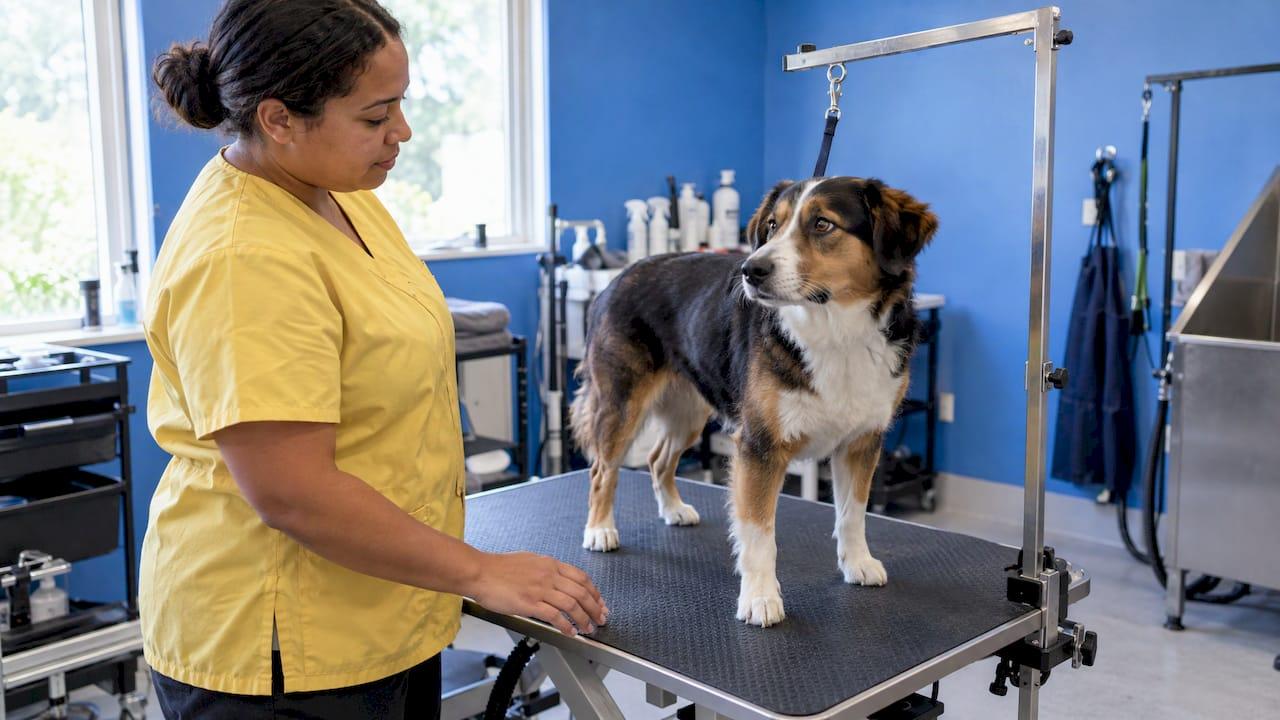
You can groom a dog that growls, snaps or bites, but not by pushing through. It takes honest disclosure to the groomer, a dog that is used to a basket muzzle, a plan for the coat, and your vet involved when fear is the real problem. Groomers are trained to refuse a dog that is unmanageable, so the best thing you can do is prepare your dog and be upfront before the appointment. At Riverside Pet Club & Resort in Central Pennsylvania, grooming is one of our core services, and this guide covers what we would want any owner in Harrisburg and the surrounding counties to know first.
TL;DR
- Tell the groomer about every growl, snap or bite before you book. A professional groomer needs your dog's behavioral history on the intake form.
- Professional standards require groomers to refuse aggressive, unmanageable pets and to report any bite to the owner. Groomers also cannot give sedatives, so any sedation goes through your vet.
- Start muzzle training at home now. Cornell's vets suggest a slow, positive process over about a week or more.
- A badly matted coat on an aggressive dog is a medical issue. Do not cut mats with scissors; call a professional or your vet.
- If your dog is fearful or reactive across the board, see your vet first. Pain and medical problems often sit behind aggression.
Table of Contents
- Why dogs get aggressive at the groomer
- Before you book: tell the groomer everything
- What groomers do with an aggressive dog
- Muzzle training: the most useful thing to do at home
- Practice handling between appointments
- When the coat is matted
- When to involve your vet or a behavior specialist
- Questions to ask any groomer
- Grooming at Riverside
- Our perspective
- FAQ
- Sources
Why dogs get aggressive at the groomer
Grooming asks a dog to do several things most dogs find hard. It must stand still on a slick table or in a tub. Strangers hold its feet, face and tail. Clippers buzz near its ears. Dryers are loud. If a dog has been hurt before, or has sore skin, matted fur or sore ears, every one of those steps can feel like a threat.
Most biting at the groomer is fear, not meanness. A frightened dog gives warnings first: stiffening, lip licking, turning the head away, a hard stare, a low growl. When those warnings get ignored, the dog learns that warnings do not work, and the next time it may skip them. That is why a dog that "bites without warning" often did warn, just quietly.
One warning sign is easy to miss. A very still, stiff dog is not a calm dog. One grooming blog describes this stillness as a dog that has hit its limit and stopped signaling, and notes that a bite can follow soon after. If your dog goes rigid on the table, the groom needs a pause, not more restraint.
Before you book: tell the groomer everything
Can you take an aggressive dog to the groomer? Yes, if you are honest about it. The American Kennel Club's national grooming education standards call for an intake form before a groomer receives a pet. It covers your contact details, your veterinarian's details, up-to-date vaccinations, breed, microchip information if available, and current medical and behavioral concerns. That last item is where you put the bite history.
Be specific. "He's a little nervous" tells the groomer nothing. These details help:
- What triggers it. Feet, face, tail, belly, clippers, dryer, being lifted, being approached from behind.
- What it looks like. Growling, snapping, lunging, a full bite, or freezing and then biting.
- When it last happened. A bite last week is different from a snap two years ago.
- What works. Treats, a slow start, a favorite spot, a break halfway through.
- Muzzle history. Whether your dog wears one calmly, tolerates it, or fights it.
- Pain or health issues. Arthritis, ear infections, skin problems, hip or shoulder pain.
Do not hide a bite to get an appointment. If the groomer is surprised mid-groom, the dog, the groomer and your relationship with the salon all pay for it. Honest information lets the groomer decide whether the dog can be groomed safely, which is the right call for everyone.
A short call or a visit before the first full groom helps too. If you are in the Harrisburg area, you can start with our grooming page for the services we list, and talk to the team about your dog's needs before you book. For dogs new to us, we also offer a 1-Time Evaluation at $20, listed on our daycare page.
What groomers do with an aggressive dog
Knowing the professional rules helps you set expectations.
Groomers must refuse unsafe dogs
The AKC standards state that groomers must refuse service to aggressive and unmanageable pets and must report any bite to the owner. A refusal is not a judgment on you. It is a safety rule that protects the dog and the person holding the clippers.
Prevention comes first
The same standards expect groomers to understand why dogs bite and to choose preventive measures: staying out of bite range, using a muzzle, a leash, a grooming loop (a light strap that gently limits how far the dog can move), or a helper who guides the dog's head away from the groomer. The goal is to lower the dog's ability to snap without raising its panic.
Calm handling matters
Groomer-training material from Groomer to Groomer magazine advises avoiding direct eye contact with an unfamiliar dog, using peripheral vision, not bending over a dog from the front, and placing a hand under the chin rather than over the head at first contact. You can copy the same habits at home: approach from the side, keep your hand low, and let the dog sniff you first.
Breaks beat force
The American Animal Hospital Association warns that manual restraint and forceful handling raise the risk of injury to both people and animals. A good groomer stops, steps back and lets the dog settle rather than holding harder. If a dog has already snapped, bitten through a muzzle, or is showing heavy stress such as drooling, vomiting or uncontrollable trembling, the right move is to stop the groom, call the owner and talk to a vet before rebooking.
Groomers cannot sedate
The AKC standards say groomers must refuse to give a dog any natural or prescription sedative and should tell clients to contact a veterinarian. If your dog needs medication to get through grooming, that decision belongs to your vet. AAHA notes that where sedatives are used, the veterinarian prescribes them and the owner gives them before the visit. Never give your dog a sedative, human or pet, on your own, and never ask a groomer to give one.
Muzzle training: the most useful thing to do at home
A muzzle is a safety tool, not a punishment, and many dogs accept one when it is introduced well. A dog that wears a basket muzzle calmly can be groomed with far less stress for everyone. AAHA encourages teaching patients to accept a basket muzzle, which lets the dog pant and take treats.

Cornell University's veterinary college gives a clear muzzle introduction plan. Introduce it slowly, in a stress-free place, with positive reinforcement. For about the first week, practice putting it on and taking it off several times a day, then slowly increase how long the dog wears it.
A simple routine that follows that approach:
- Hold the muzzle out with a treat inside the basket. Let your dog put its nose in by choice.
- Repeat until your dog pushes into it eagerly.
- Add a few seconds of wearing it, treating the whole time, then take it off.
- Build up wear time over days, not minutes. Stop before your dog gets upset.
- Practice in the car and at the door, so the muzzle does not only appear at a stressful moment.
If your dog already fights the muzzle, do not force it on. Slow down to an earlier step. Tell the groomer where you are in the process.
Practice handling between appointments
Short, happy practice sessions help a dog accept being touched. Start with the places your dog likes and move toward the harder spots.
- Touch a paw for one second, treat, and stop.
- Handle one ear, then the other, with a treat after each touch.
- Let your dog explore the brush, the dryer (switched off) and the nail grinder (switched off) before they are used.
- Keep sessions to a minute or two and end while your dog is still relaxed.
This is the same idea behind our own approach to gentle dog grooming: short steps, a calm pace and a dog that is allowed to say when it needs a break. Ending a session before your dog escalates teaches the dog that its warnings work, and that is what keeps a growl from turning into a bite.
Plan the groom around a shorter job too. A short appointment is easier on a nervous dog than a full groom. Our grooming page lists add-on services you can book on their own, such as Nails/Ears at $15, Express Groom at $25 and Furminating/De-Shedding at $25. A bath runs $47 to $78. Starting with one small service lets your dog build a good experience before a longer session.

When the coat is matted
Matting is the hardest situation. A matted dog hurts when brushed, so it fights more, and the mats get worse. It is a cycle.
The ASPCA warns that severe mats can form tight bands, most often on a leg, that cut off blood supply and cut into the skin. It says a badly matted pet may need sedation and a full-body clip, and that owners should never cut mats out with scissors. PetMD's matting guide adds that tight, large, painful or sensitive-area mats call for professional help, and extensive mats or suspected skin damage need a veterinary exam. Sedation or anesthesia may be recommended so the mats can come off without needless pain.
In practice:
- Do not wait. Mats get worse every week.
- Do not use scissors. A wriggling dog and a sharp blade cause deep cuts.
- Expect a short clip. Shaving the coat close is often kinder than long brush-outs. It is faster and hurts less than working through tight mats with a brush.
- Call your vet if the skin looks red, raw or broken, or if your dog is clearly in pain. The vet can examine the skin and decide whether sedation is the safest route.
For dogs that stay on a regular schedule, dematting is listed on our grooming page at $25 per half hour, and a Trim starts at $12. Frequent short visits prevent the matting that makes grooming so painful in the first place.
When to involve your vet or a behavior specialist
Sometimes grooming aggression is a symptom of something bigger. Call your veterinarian first if your dog has painful mats, skin disease, ear problems, or becomes very fearful whenever it is groomed. Pain is a common reason a dog suddenly starts to bite when touched.
The MSD Veterinary Manual explains that a vet must check for medical causes and assess the risk of injury before treating aggression. For moderate or severe aggression, general practice vets should refer to, or consult with, a board-certified veterinary behaviorist.
Cornell's behavior service describes what such a visit looks like: an initial consultation of about 90 minutes, a review of medical and behavior history, a risk assessment, treatment options and an immediate safety and management plan. Cornell also recommends avoiding known triggers until the visit. If grooming is the trigger, that may mean pausing full grooms and keeping the coat short in the meantime.
A referral is not a failure. As the Los Angeles Times puts it, it is a practical step, because the problem may be medical rather than a matter of willpower or training. It also reports that severe aggression warrants a specialist consultation, and that treatment often combines behavior work with medication.
Questions to ask any groomer
Before you book, ask the questions that show how a salon handles a nervous dog:
- Do you ask about bite history on the intake form?
- How do you handle a dog that growls or freezes? Do you stop and give the dog a break?
- Do you use basket muzzles, and will you work with a muzzle my dog already knows?
- Can my dog start with a short visit?
- What happens if my dog cannot be groomed that day? Will you call me?
- Do your groomers have training in low-stress handling?
Training programs exist. The AKC S.A.F.E. Dog Grooming Program requires groomers to complete the Safety in the Salon course, pass its test and pledge to the Groomer/Salon Oath. The Fear Free groomer certification teaches groomers to read body language, desensitize dogs to tools and build calm surroundings; groomers must pass each module with 80% or higher. Asking about training of this kind tells you how seriously a salon takes handling.
Grooming at Riverside
We offer professional dog grooming for dogs in Harrisburg and across Dauphin, Cumberland, Perry, York and Lebanon counties. Our grooming page lists everything from a Bath ($47 to $78) and Trim (from $12) to Specialty Cut (from $30), Teeth Brushing ($15) and Anal Glands ($10). If your dog stays with us for boarding, a bath with nails and ears can be added to the stay, and daycare guests can add grooming to the day.
Our dogs are cared for in large, climate-controlled kennels with advanced air filtration, and the facility has a 24-hour security system. If your dog is new to us, the $20 1-Time Evaluation on our daycare page is a good first step.

See the full service list and prices on our grooming page, or read how we think about reactive dogs in group play and boarding dogs with special needs if your dog has needs beyond grooming.
Our perspective
Most owners who search for how to groom an aggressive dog are worried, a little embarrassed and short on time. We want you to know that none of that is unusual.
What we believe: a dog that bites at grooming is a dog that needs a calmer plan, not a harsher one. Safety comes first, for your dog and for the people handling it. That means honest information at the start, a pace that suits the dog and a willingness to stop when the dog says stop.
It also means looking at the whole picture. Matted coats, sore ears and a long day at a strange place all add up. Regular, shorter grooms, a coat kept at a manageable length and a dog that knows its handlers make grooming easier over time. That is why we put personalized care and safety at the center of how we look after dogs, whether it is grooming, daycare or boarding.
If you are not sure where to begin, talk to us about your dog. Tell us what happens and what helps, and we will take it from there.
Alexis
FAQ
How do groomers deal with aggressive dogs?
They prevent bites first. That means reading the dog's body language, staying out of bite range, and using tools such as a muzzle, a grooming loop or a helper to guide the head. Under AKC standards, groomers must refuse dogs that are unmanageable and must report any bite to the owner.
Can you take a dog that bites to the groomer?
In many cases yes, but tell the groomer about the bite history when you book. A professional intake form asks about behavioral concerns for this reason. The groomer can then decide whether to groom the dog, suggest a short first visit or ask you to see your vet first.
Can a groomer sedate my dog?
No. AKC standards say groomers must refuse to give natural or prescription sedatives and should refer clients to a veterinarian. If your dog needs sedation, your vet decides on it and prescribes it.
What if my dog is aggressive and badly matted?
Do not cut the mats yourself. Severe mats can cut into the skin and may need clipping under sedation, which a vet manages. Call your vet if the skin is red, raw or painful, and book a professional groom as soon as the coat can be handled safely.
Should I see a vet before grooming an aggressive dog?
Yes, if the aggression is new, sudden or severe. Pain and medical problems often drive aggression, and your vet can check for them. For moderate or severe cases, the vet may refer you to a veterinary behaviorist.
Sources
- AKC National Core Professional Dog Grooming Educational Standards (PDF)
- Groomer's Guide to Aggressive Dogs, Groomer to Groomer
- Humane restraint of animals, AAHA
- Muzzle choices, Cornell University College of Veterinary Medicine
- A Haircut Could Save a Life, ASPCA
- How To Handle Matting in Dogs and Cats, PetMD
- Behavior Problems of Dogs, MSD Veterinary Manual
- Behavior Medicine, Cornell University College of Veterinary Medicine
- When to Call a Veterinary Behaviorist for Your Pet, Los Angeles Times
- AKC S.A.F.E. Dog Grooming Program
- Fear Free Groomer Certification Program