
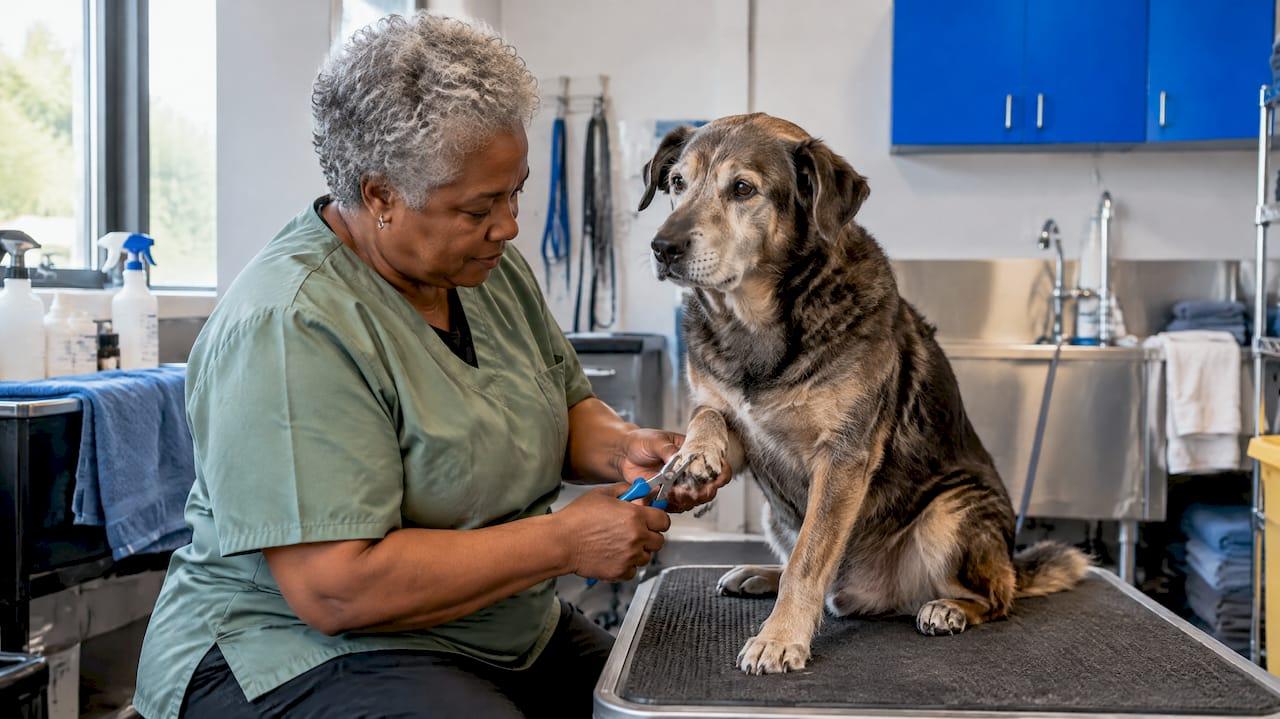
Grooming an older dog works best when it is short, calm and well supported. Plan for brief sessions, a non-slip surface, a gentle touch and regular breaks. Tell your groomer about your dog's health before the first brush touches the coat. The same planning helps when your senior dog needs to stay with us overnight. This guide covers what changes with age, how often to brush and bathe, what to share with a groomer, and how to prepare an older dog for boarding.
TL;DR
- Dogs are usually considered seniors at about 75% of their expected lifespan. For large breeds that can be 7 to 8 years, and for small dogs around 10.
- Short, frequent sessions are easier on stiff joints than one long groom. Use a non-slip surface, a warm room and a supportive position.
- Tell the groomer about arthritis, hearing or vision loss, skin changes, medications and anything that stresses your dog.
- Ask a veterinarian about new lumps, rashes or sudden coat changes. A groomer should not give sedatives or medication.
- For boarding, share your dog's routine, mobility needs and medication schedule in advance, and ask how the facility handles them.
Table of Contents
- When is a dog a senior?
- What changes about grooming as dogs age
- The most comfortable way to groom a senior dog at home
- How often should you brush, bathe and book a groomer?
- Nails, teeth, ears and the other small jobs
- What to tell the groomer before the appointment
- Signs a grooming session should stop
- A note on grooming and daycare for seniors
- Boarding an older dog
- Our perspective
- Book your senior dog's visit
- FAQ
- Sources
When is a dog a senior?
There is no single birthday. VCA explains that a dog is considered senior at about 75% of its lifespan and geriatric once it passes its life expectancy. Large dogs may be seniors at 7 to 8 years. Small dogs may not reach that point until around 10.
So a 9-year-old Great Dane and a 9-year-old Chihuahua are in very different places. Go by your dog's body and behavior, and use your veterinarian's view of its age group.
PetMD lists common signs of aging:
- Lower energy
- Fading hearing or vision
- Cognitive changes
- Arthritis or other mobility problems
- A gray muzzle and coat
- Skin that is less elastic
Every one of these changes how a grooming session should go.
What changes about grooming as dogs age
A groom that was easy at age three can be tiring at age twelve. These are the changes that matter most.
Joints and standing
Standing on a slippery table or holding a leg up for a nail trim can hurt a dog with arthritis. Long sessions make it worse. Good senior grooming lets the dog sit or lie down when it needs to, supports the body instead of forcing a position, and pauses often.
Skin and coat
Vista Hills Animal Hospital advises a gentle touch with senior dogs because older skin is often more sensitive. Avoid pulling on the fur or skin. Brush slowly, with a soft brush, and stop if your dog flinches.
Hearing and vision
A dog that cannot hear you coming may startle when touched. The same veterinary guidance says to approach a dog with hearing loss calmly. Let it see or smell your hand first, then touch a shoulder or the chest rather than reaching over the head.

Stamina and stress
Older dogs tire sooner. A groom that once took two hours may need to be split up or kept simple. Many seniors do better with a basic bath, nails and a tidy trim than with a full styling session.
The most comfortable way to groom a senior dog at home
Try brushing in short sessions instead of one long weekly groom. Purina's senior grooming guide suggests short daily sessions, each focused on a different part of the body. It also suggests letting the dog lie down, ideally in its own bed, with pillows or a supportive harness if needed.
Here is a simple routine:
- Pick a calm time, such as after a walk or meal, when your dog is relaxed.
- Let your dog lie on its bed or on a non-slip mat. Keep the room warm.
- Spend five minutes on one area: back one day, chest and legs the next, face and ears after that.
- Offer a treat and a quiet word between areas.
- Stop when your dog turns away or sighs. Try again tomorrow.
Daily brushing helps in another way. VCA notes that it helps with hard-to-reach areas that arthritis makes difficult for the dog to groom itself. It also lets you check the coat and skin often, so you spot changes early.
How often should you brush, bathe and book a groomer?
The answer depends on coat type and health, so treat the numbers below as a starting point.
| Task | General guidance | Source |
|---|---|---|
| Brushing, smooth or short dense coats | About once a week | ASPCA |
| Brushing, long silky coats | Daily | ASPCA |
| Bathing | At least once every three months, more often for dogs with skin problems or lots of outdoor time | ASPCA |
| Professional grooming | Varies by dog and breed, as often as monthly for some long-haired dogs | GeniusVets |
GeniusVets also recommends brushing at least weekly, and more often for long-haired dogs, heavy shedders and dogs that get wet. It suggests talking to a professional groomer about a schedule built around comfort. For a senior dog that usually means shorter visits that come at regular intervals, so the coat never gets a chance to mat.
Bathing without irritation
The ASPCA's advice for bath time applies even more to older dogs:
- Use lukewarm water and a shampoo made for dogs.
- Keep water out of the ears, eyes and nose.
- Dry your dog thoroughly, and keep the room warm so it does not get chilled.
- Do not over-bathe. The ASPCA warns that bathing too often can irritate the skin.
The same ASPCA flyer says to brush out mats, or clip them with electric clippers, before a bath. Never use scissors to cut a mat close to the skin. Older skin is thin and loose, and it is easy to nick. If a mat is tight, leave it to a professional.
Nails, teeth, ears and the other small jobs

Small tasks matter more in a senior dog. Long nails change how a dog stands and walks, which is hard on sore joints. Ears and teeth are easier to check at a grooming visit than at home for many dogs.
At Riverside, these are priced separately so you can add only what your dog needs. These are the prices published on our grooming page as of this writing:
| Service | Price |
|---|---|
| Nails/Ears | $15 |
| Nails, grinding | $15 |
| Teeth brushing | $15 |
| Anal glands | $10 |
| Express groom | $25 |
| Furminating/de-shedding | $25 |
| Dematting, per half hour | $25 |
| Bath | $47-$78 |
| Trim | from $12 |
Bath pricing runs across a range, and we confirm the final price when we see your dog. Check the grooming page for the current list.
What to tell the groomer before the appointment
A good groom starts with a good conversation. The American Kennel Club's professional grooming educational standards say that geriatric dogs need accommodations for age-related needs. They also say owners should share current medical and behavioral concerns, and groomers should learn about any known behavior tendencies or triggers.
Before you book, have this list ready:
- Mobility: Can your dog stand for long? Does it slip, struggle with stairs or avoid having its back legs touched?
- Senses: Is it deaf, going blind or easily startled?
- Skin and coat: Any sore spots, hot spots, lumps, or places where it dislikes being touched?
- Health conditions: Heart, breathing, kidney or other conditions that affect stamina.
- Behavior: Noises, dryers, clippers or handling that have upset it before.
- Past grooming: What went well, what did not and how long it can tolerate.
If your dog is on medication, give the groomer the information. The AKC standards say groomers should refuse to give natural or prescription sedation or medication and should refer clients to a veterinarian. That is a safety rule, and a good one. If your dog is too anxious to groom without sedation, talk to your vet first.
Similarly, if you find a new lump, a rash or a sudden coat change, have a veterinarian assess it, as Vista Hills advises. Do not wait for the next groom to ask.
For more on what a calm approach looks like, read our guide to gentle dog grooming.

Signs a grooming session should stop
Watch your dog rather than the clock. Pause or end the session if you see:
- Panting that does not settle
- Trembling or shaking
- Trying to lie down or pull away
- Whining, stiffening or snapping
- Lifting a paw or favoring one side
A short, finished groom beats a long one that leaves your dog sore and stressed. You can always book the rest for another day. If you want a simple nail trim, an express groom or just a bath, say so when you book.
A note on grooming and daycare for seniors
Many older dogs still enjoy company. Some lose interest in big, fast play groups, while others like a quieter day with other dogs. We offer a one-time evaluation for $20 so we can see how a dog does before it joins a group. If your senior is sensitive or reactive in groups, our article on reactive dog daycare explains how we think about fit.
Boarding an older dog
Boarding a senior dog can work well when your dog is stable and the facility knows its routine. It takes more planning than boarding a young dog. Start by asking whether your dog's health is steady enough for time away from home. If it has new or unstable symptoms, such as collapse, trouble breathing, repeated vomiting or a refusal to eat or drink, talk to your veterinarian before you make any plans. Your vet knows your dog's history and can tell you if staying in a kennel is a good idea.
How to prepare your senior dog for boarding
Give the facility the details a family member would need:
- Daily routine. Feeding times, portion sizes, walk times and when your dog usually goes to bed.
- Mobility. Whether it needs help on stairs, slips on smooth floors or needs a softer place to lie down.
- Medications and supplements. Names, doses, times and how your dog takes them. Bring them in the original containers, with written instructions.
- Health contacts. Your veterinarian's name and number, and a phone number where you can be reached while you travel.
- Comfort items. A familiar bed or blanket if the facility allows it.
- Bathroom habits. Older dogs often need to go out more often, and some have accidents.
If you can, do a short visit or a single day first. A one-day stay lets your dog get used to the place before a longer trip. At Riverside, daycare with a 1-day stay is $22 per day, and daycare with boarding is $22 per day. Enrichment daycare with play groups is $32 per day. You can find the details and current prices on our daycare and boarding pages.
What to ask any boarding facility
When you tour or call, ask about the things that matter to an older dog:
- Supervision. How often will staff check on your dog, and is anyone there overnight?
- Environment. Is the kennel large enough for your dog to lie down and stretch, and is the temperature controlled? Are the floors slippery?
- Air quality. Is the air filtered? Clean, fresh air is easier on aging lungs.
- Medication. Will staff give medication on your schedule, and how do they record it?
- Emergencies. What happens if your dog gets sick, and which veterinarian will be called?
- Exercise. Can your dog go for shorter, gentler walks instead of rough group play?
- Vaccines. What records does the facility require, and when?
At Riverside, our kennels are large and climate controlled, with advanced air filtration, and we run a 24-hour security system. Boarding is $45-$50, and you can add a bath that includes nails and ears for $47-$78. A Riverview walk of 10 to 15 minutes is $10, which can suit a dog that prefers a slow stroll to a play yard. See our boarding page for the current details. If your plans change and you need a longer stay, our guide to extended stay dog boarding covers what to plan for.
Boarding and grooming in one trip
Bathing your dog on the way out means it comes home clean, and you skip the grooming appointment later. Ask us to add a bath to your dog's stay so it is done before pickup. For a senior, it also means one less trip.
Our perspective
Older dogs are some of our favorite guests. They know what they like, and they let you know it. What they need from us is patience.
We believe senior care comes down to a few things: a clean, comfortable space, a team that pays attention, and clear information from you. That is why we built Riverside around large, climate-controlled kennels, advanced air filtration and 24-hour security. A healthier environment and a safe building are a good start for a dog of any age.
For grooming, we like to keep things simple and kind. Tell us what your dog can and cannot do, and we will work with that. A quick bath, a nail trim and a tidy-up is often better for an older dog than a long session. We would rather do a little and do it well.
Come in, meet the team and tell us about your dog. We will take it from there.
Alexis
Book your senior dog's visit
Whether your dog needs a gentle bath, a nail trim, a day of daycare or a stay while you are away, we can help. Riverside Pet Club & Resort serves dog owners across the Harrisburg area and Central Pennsylvania. Our grooming menu is priced by service, so you pay only for what your dog needs. Tell us about your dog's age, health and routine when you book, and we will plan around it.

See grooming services and prices, or book boarding for your dog today.
FAQ
What is the best way to groom a senior dog?
Go short, slow and gentle. Use a non-slip surface, let your dog lie down or sit, keep the room warm, and take breaks. Brush for a few minutes at a time on different areas of the body, and stop when your dog shows signs of stress. Tell any groomer about arthritis, sensitive skin and hearing or vision loss before the visit.
What is a senior dog groomer?
It is a groomer who adjusts the service to an older dog's needs. There is no single license for it. The AKC's educational standards say geriatric dogs need accommodations for age-related needs. Ask any groomer how they handle stiff joints, short sessions and nervous dogs, and what they need to know about your dog first.
At what age is a dog considered geriatric?
It depends on the size and breed. VCA says dogs are senior at about 75% of their lifespan and geriatric once they have passed their life expectancy. Large dogs may be senior at 7 to 8, and small dogs around 10. Your veterinarian can tell you where your own dog stands.
Can an older dog stay at a boarding facility?
Often yes, if your dog is medically stable and the facility can meet its routine. Share its feeding, medication and mobility needs ahead of time, and ask how staff will handle them. If your dog has unstable or worsening symptoms, ask your veterinarian before you book.
How often should I groom my older dog?
Brush at least once a week, and daily for long coats, using short sessions. Bathe no more often than needed, since too many baths can irritate skin. Professional visits vary by coat and breed, so ask your groomer for a comfort-focused schedule.
Sources
- Helping our Senior Dogs Age Gracefully, VCA Animal Hospitals
- When Is a Dog Considered a Senior? PetMD
- Pet Grooming for Senior Dogs: Special Considerations and Tips, Vista Hills Animal Hospital
- Senior Dog Grooming Information: Ageing Gracefully, Purina
- Dog Grooming Tips, ASPCA
- Grooming Your Pet, ASPCA
- Dog Grooming, GeniusVets
- AKC National Core Professional Dog Grooming Educational Standards