
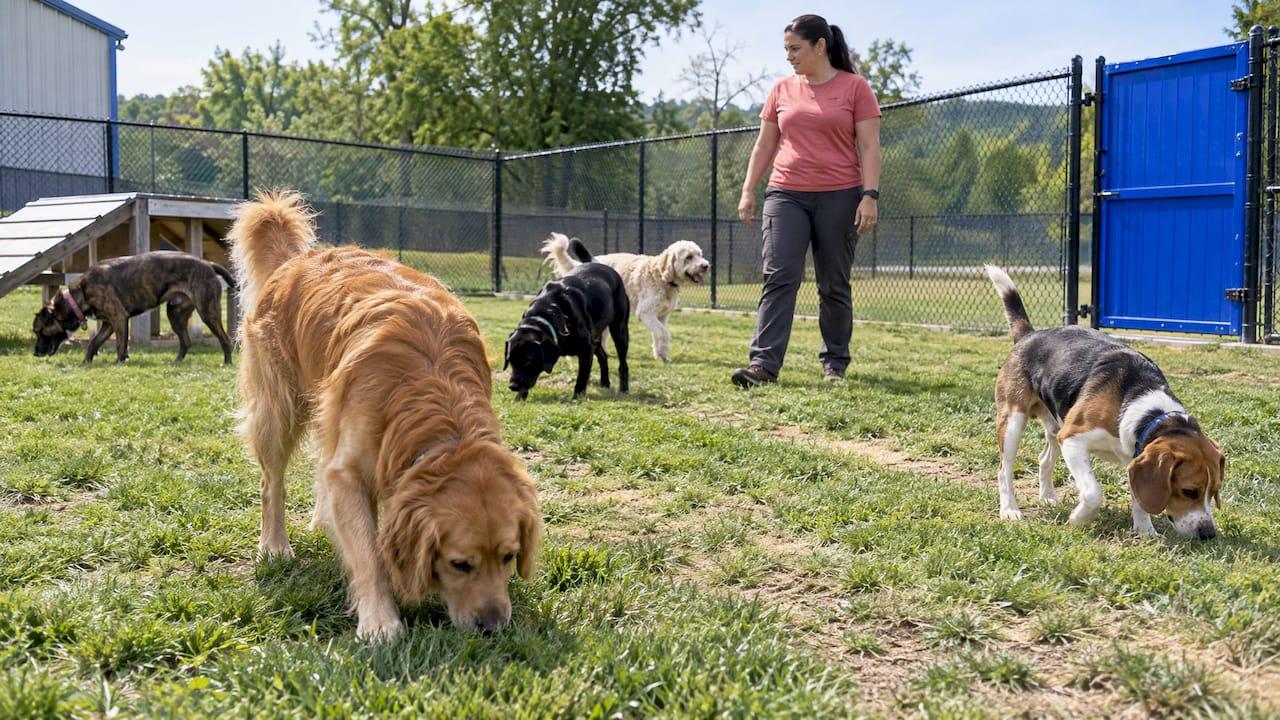
An outdoor dog daycare gives your dog room to run, but the space is only half of what makes a day good. Fencing, staff placement, rest time and a plan for weather matter just as much. In Central Pennsylvania, where summers get hot and winters get cold, the best daycare is one that keeps your dog active and also gives your dog a safe, comfortable place to settle down. At Riverside Pet Club & Resort in the Harrisburg area, our daycare uses supervised play groups, and our kennels are large, climate-controlled and fitted with advanced air filtration for rest time.
This guide explains how outdoor daycare works, what to check before you enroll, how to judge whether a high-energy dog is a good fit, and what daycare costs.
TL;DR
- Outdoor daycare is a large play area, often indoor/outdoor or outdoor-only, where dogs run and play under staff supervision.
- Check for at least a 6-foot fence, double-door entry, staff spread through the play area, and groups matched by size and play style.
- High-energy, social dogs often do well. Look for a daycare with a trial or evaluation and scheduled rest.
- Ask about hot and cold weather plans, vaccine requirements and what happens after a scuffle or injury.
- Our daycare runs $32 a day for Enrichment Daycare with play groups, with a $20 one-time evaluation to start.
Table of Contents
- What outdoor dog daycare is
- Safety features to check
- Weather: the part outdoor daycare owners forget
- Rest is part of the program
- Is outdoor daycare right for a high-energy dog?
- Can a puppy go to outdoor daycare?
- What outdoor dog daycare costs
- Questions to ask on a tour
- Our view on what a good day looks like
- Book a daycare evaluation at Riverside
- FAQ
- Sources
What outdoor dog daycare is
Outdoor dog daycare is a style of group care built around open space. Preventive Vet describes it as a large area, often indoor/outdoor or outdoor-only, where dogs can run, play fetch with staff, explore or watch from the sidelines. Some facilities split dogs by energy level, play style or size. Good ones plan for the weather.
The idea is simple. Your dog spends the day moving, sniffing and playing with other dogs instead of waiting alone at home. Most owners look for it because their dog is young, athletic or bored, and a walk around the block does not tire them out.
There are a few common setups:
- Outdoor-only yards. Dogs spend the whole day outside. The weather decides how comfortable the day is.
- Indoor/outdoor access. Dogs can move between a yard and an indoor area. This is the most flexible option in a state with real seasons.
- Indoor play with scheduled outdoor breaks. Dogs get fresh air and exercise in shifts, with supervised time in between.
None of these is right for every dog. What matters is whether the program is managed well, which is what the rest of this guide covers.
Safety features to check
Open space brings open-space risks: escapes, crowding, rough play and heat. Several professional groups agree on what a safe facility looks like. Here is a checklist you can use on a tour.
Fencing and entry points
Preventive Vet recommends at least a 6-foot fence, says dogs should never be left unsupervised, and points to double-door entry as a way to prevent escapes. The American Kennel Club's 2026 guide also advises checking that the facility is clean and organized, securely fenced and free of hazards.
Walk the perimeter if you can. Look for gaps at the bottom of the fence, gates that latch on their own and anything a dog could climb or chew.
Staff placement and training
In a large play area, staff should be spread out across the space. Preventive Vet notes that this lets them watch safety and dog interactions up close, rather than supervising from a distance. A single person standing at the gate cannot see what is happening in the far corner.
Staff should also be able to read dog body language. The AKC's guide says staff should know basic care and safety and ideally recognize signs of danger, stress or illness. You can ask about canine first-aid training and how they reach owners in an emergency.
VCA Hospitals suggests a staff-to-dog ratio of no more than 15 dogs per person, plus separate playgroups for large and small dogs, temperament testing before acceptance and positive reinforcement instead of punishment. Use these as questions on your tour.

What happens when something goes wrong
Dogs play hard, and scuffles happen. The Animal Humane Society recommends asking how staff handle scuffles and injuries, how they assess an incident, how they tell owners and how they decide when a dog may come back. Ask what the plan is for a dog that becomes stressed or over-aroused. A good answer includes pulling the dog out of the group for a break.
The same guide asks owners to check the facility layout and cleaning routines and whether they can view the daycare area.
Vaccines and parasite prevention
A daycare should require current vaccines and parasite prevention. Core dog vaccines include distemper, parvovirus, adenovirus and parainfluenza, with rabies given from 12 weeks of age at a minimum. Bordetella, Lyme and canine influenza are non-core vaccines chosen based on risk, including a facility's requirements, according to The Ohio State University's veterinary socialization checklist. Your vet can tell you what your dog needs. If your dog is due for shots or flea, tick and heartworm prevention, veterinary vaccinations and preventive care are the place to start before the first day of daycare.
Weather: the part outdoor daycare owners forget
Pennsylvania weather swings from humid 90-degree afternoons to freezing mornings. Preventive Vet says to ask about hot and cold weather plans, and outdoor facilities should have a clear answer.
When you tour, ask:
- Where do dogs go when it is very hot, cold, wet or icy?
- Is there shade and fresh water in the play area?
- Do dogs get indoor breaks, and how long are they?
- Is the indoor area heated and cooled, or only covered?
This is where the building matters as much as the yard. Our kennels are large and climate-controlled, with advanced air filtration, so a dog that has finished playing has a comfortable place to rest. If you want to know what good climate control looks like, we wrote a guide on climate controlled dog kennels.

Rest is part of the program
A day of non-stop running is not the same as a good day. Preventive Vet recommends a consistent routine, and says scheduled naps, rotations between higher- and lower-energy areas, or limited play times may reduce overstimulation, injury and exhaustion.
The AKC adds that a good program offers varied activities for dogs with different energy levels and a comfortable designated rest area. It suggests asking whether dogs are crated and for how long.
After a day at daycare, a tired dog should be relaxed, not wired. If your dog comes home panting heavily, pacing, shaky or off their food, tell the staff. Pay attention if recovery takes more than a day or if several signs show up together. A pattern is more meaningful than one odd moment. If your dog seems unwell, call your veterinarian.
Is outdoor daycare right for a high-energy dog?
Often, yes. Social dogs who love to run tend to suit open-space daycare, according to Preventive Vet. Dogs that are cautious or easily overwhelmed may do better in a smaller or quieter setup.
High energy does not always mean high sociability. A dog can be athletic and still dislike crowds. Here is how to think about your dog:
- Loves other dogs, plays well, bounces back quickly. A large play group with plenty of running is a strong match.
- Loves running but plays rough or gets pushy. Look for a facility that matches groups by energy and play style, and that watches closely for over-arousal.
- Nervous, easily startled or reactive. A smaller group or a different format may serve your dog better. Our guides on reactive dog daycare and small dog daycare cover those situations.
Ask for a trial or evaluation
Preventive Vet suggests asking about a trial, how groups are matched and what signs tell staff a dog needs a break. We start every new dog with a 1-Time Evaluation for $20, so staff can see how your dog handles the environment and other dogs before regular days begin.
Add mental work to physical work
A high-energy dog needs more than laps around a yard. Mental effort tires a dog in a different, calmer way. Our list of dog enrichment activities has ideas for home, and our Enrichment Daycare pairs supervised play groups with a full day of activity.
Can a puppy go to outdoor daycare?
Most puppies should wait until their core vaccine series is complete, typically around 16 weeks, before joining general daycare. That is the guidance from a veterinary practice's daycare guide. The Ohio State checklist lists core puppy vaccine boosters every 3 to 4 weeks through 16 to 20 weeks, so ask your vet exactly where your puppy stands in the series.
Socialization still matters during that window. Ohio State's veterinary team says you can socialize and protect against disease at the same time. They suggest controlled settings with known, vaccinated dogs and structured puppy classes that require vaccination. It also helps to prepare your home for the new arrival. This guide on how to puppy proof your house covers the basics.
A note on the "7-7-7 rule" you may see online: it is a loose socialization checklist, not a rule, so do not treat it as a schedule for daycare.
What outdoor dog daycare costs
Daycare prices vary by city, format and what is included. Dog boarding, for comparison, averages $40 to $60 per night according to Care.com's 2026 guide, with price depending on the facility, location, supervision and enrichment.
It helps to know what the fee covers. The Animal Humane Society suggests asking about the daily routine, playgroups, enrichment, added feeding costs and medication procedures, plus accommodations for reactivity or noise sensitivity.
Here are our daycare prices, as published on our site:
| Service | Price |
|---|---|
| Enrichment Daycare, play groups | $32 per day |
| 1-Day Stay | $22 per day |
| 1-Time Evaluation | $20 one-time |
| Daycare with Boarding | $22 per day |
| Doggy Daycare with Grooming | $22 |
Boarding is $45 to $50. You can add a bath that includes nails and ears for $47 to $78. A Riverview walk of 10 to 15 minutes is $10. See our boarding page for details. Prices are the ones listed on our site and may change, so check the page when you book.
Questions to ask on a tour
Bring this list. Good facilities are glad to answer.
- How tall is the fence, and is there a double-door entry?
- How many staff are in the play area, and how many dogs per person?
- How do you group dogs: by size, energy or play style?
- What do you do in hot, cold and wet weather?
- When and where do dogs rest? Are they crated, and for how long?
- What vaccines and parasite prevention do you require?
- How do you handle scuffles, injuries and stressed dogs, and how do you tell owners?
- Can I see the play and rest areas?
- Do you offer an evaluation or trial day?
If you are comparing options across the region, our guide to dog daycare in Pennsylvania walks through choosing one. For the bigger picture on why dogs benefit, read dog daycare benefits.
Our view on what a good day looks like
We think a great daycare day has three parts: exercise, attention and real rest.
Exercise gets the headlines, especially for an energetic dog. But a dog that runs all day with no break can go home overtired, not content. That is why we care so much about the space where a dog rests. Our kennels are large and climate-controlled, with advanced air filtration, so the quiet part of the day is as comfortable as the active part.
Attention means people who watch your dog closely. We focus on safety and personalized care, and we run supervised play groups so your dog's day is not left to chance. A 24-hour security system adds peace of mind for owners.
Our advice is simple. Start with an evaluation, let your dog build up to full days, and pay attention to how they act when they come home. A happy, tired dog is the goal.
Alexis
Book a daycare evaluation at Riverside
Riverside Pet Club & Resort serves dog owners across the Harrisburg area and Central Pennsylvania. Our dog daycare offers Enrichment Daycare with play groups at $32 per day and a 1-Day Stay at $22 per day. New dogs begin with a 1-Time Evaluation for $20. If you also need boarding or grooming, you can add a bath or book a grooming service on the same visit.

To get started, visit our daycare page and schedule your dog's evaluation.
FAQ
Is outdoor dog daycare safe?
It can be, when the facility has secure fencing, staff spread across the play area and a plan for separating over-aroused dogs. Preventive Vet recommends at least a 6-foot fence and says dogs should never be left unsupervised. Tour the space and ask how staff handle injuries.
How do I know if my high-energy dog is ready for daycare?
A dog that enjoys other dogs, recovers well from excitement and responds to staff is usually a good candidate. A short evaluation shows how your dog behaves in a group. We start new dogs with a $20 1-Time Evaluation.
Can a puppy go to dog daycare?
Most puppies should wait until their core vaccine series is finished, typically around 16 weeks. Until then, use controlled settings with known, vaccinated dogs and puppy classes that require vaccination. Your veterinarian can confirm where your puppy is in the series.
How much does dog daycare cost?
It depends on the facility and format. At Riverside, Enrichment Daycare with play groups is $32 per day and a 1-Day Stay is $22 per day. Check our daycare page for current pricing and what each option includes.
Sources
- How to Choose a Dog Daycare, Preventive Vet
- 4 Types of Questions to Ask a Dog Daycare Before Enrolling, Animal Humane Society
- How to Choose the Best Doggy Daycare, American Kennel Club
- How To Choose A Doggy Day Care, VCA Hospitals
- Dog Daycare: What to Ask, Vaccine Requirements, and Safety
- You CAN Have Both!, The Ohio State University
- Dog Boarding Cost Guide, Care.com