
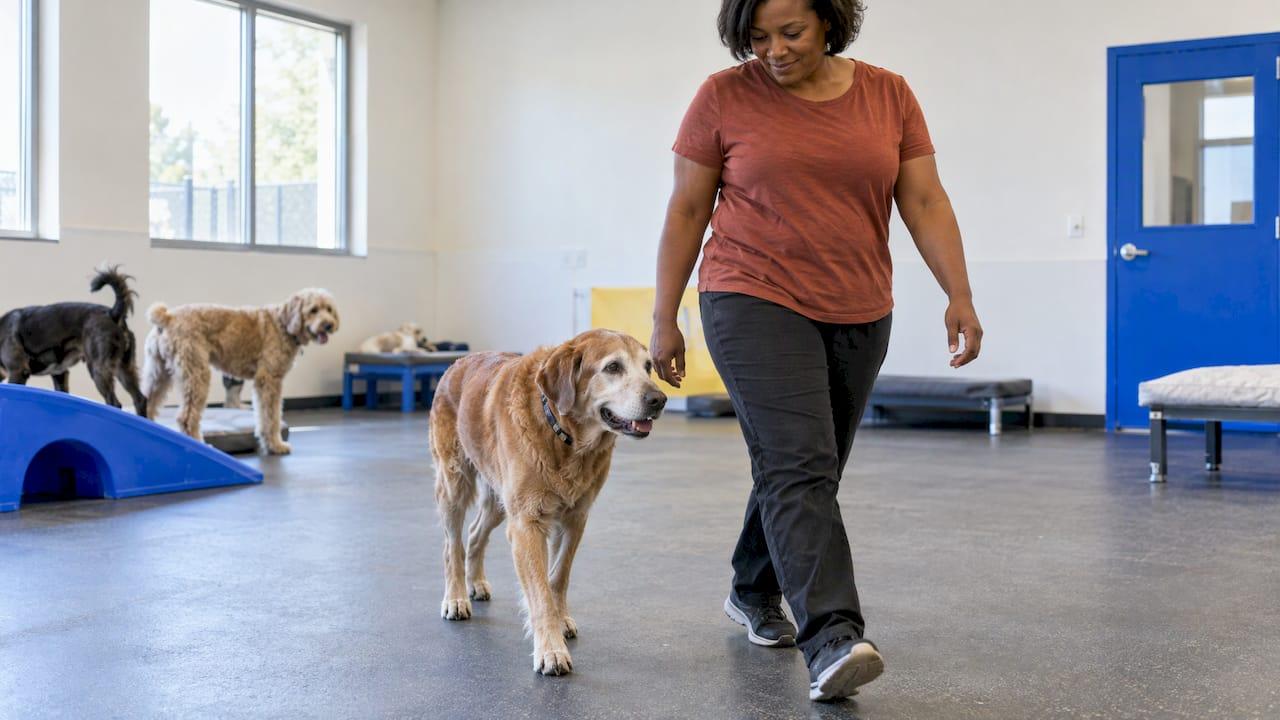
Many older dogs enjoy daycare, as long as the day is built around their pace. That means a calm group, a comfortable floor, a real rest schedule and staff who know your dog's health needs. If you live in the Harrisburg area, we can help you find out whether that works for your dog. Our dog daycare runs supervised social and play programs, and our large, climate-controlled kennels with advanced air filtration give your dog a quiet place to rest between activities.
This guide explains what changes for a senior dog, how to tell if daycare suits yours, what to ask any provider, and how to read your dog's signals after the first visits.
TL;DR
- A senior dog's tolerance for busy group play often narrows with age. That is a normal change, not a behavior problem.
- Look for a calm group, secure footing, regular rest breaks and a plan for medication and temperature comfort.
- Talk to your veterinarian before enrolling if your dog has pain, hearing or vision changes, or tires easily.
- Start with a short trial and watch how your dog eats, sleeps and behaves that night.
- At Riverside, a 1-Time Evaluation is $20, and a 1-Day Stay is $22 per day.
Table of Contents
- What changes for dogs as they age
- Is daycare a good fit for your senior dog?
- What a good senior-friendly daycare day looks like
- Questions to ask any daycare
- How a first trial should work
- Reading your dog's signals
- If a full day is too much
- Our perspective
- Daycare at Riverside
- FAQ
- Sources
What changes for dogs as they age
A dog does not become "senior" on one birthday. Large breeds tend to slow down earlier than small ones, and every dog ages at its own speed. What matters is what you see at home: slower mornings, hesitation on stairs, more naps, less interest in rough play.
Those changes matter at daycare because a play yard is built around movement. Advanced Veterinary Medical Center notes that a dog's tolerance for group play narrows with age. A dog who thrived in a crowded playroom at two may want one or two familiar friends at eight. The clinic calls that shift normal.
The practical things that change are these:
- Joints and footing. Slippery floors and sudden turns are harder on stiff hips and knees.
- Stamina. Long stretches of activity tire an older dog faster, and recovery takes longer.
- Temperature. Older dogs may be less comfortable in heat or cold.
- Senses. Hearing and vision loss make a busy room more confusing.
- Medication. Joint pain medication and other prescriptions follow a daily schedule that has to continue while your dog is away from home.
None of this rules out daycare. It means the details of the setup matter more than they would for a two-year-old.
Is daycare a good fit for your senior dog?
Start with your dog, not the facility. Ask yourself a few plain questions:
- Does your dog still greet other dogs with interest?
- Does your dog play for a while and then settle easily?
- Is your dog comfortable on hard floors, with no slipping or hesitation?
- Does your dog eat and sleep normally after a busy day?
- Is any pain or health condition well controlled?
If the answers are mostly yes, daycare is likely a good option to try. A veterinary hospital, Twin Maples, lists signs that call for more caution: a dog who becomes overwhelmed or shuts down in busy places, has fear-based reactivity or strong resource guarding, has medical conditions that limit activity, or is a senior who tires easily or has mobility limits. It suggests a pre-daycare wellness visit so your vet can assess comfort and suggest the right plan.
A vet visit is the right step if your dog has pain, hearing loss, vision changes or another health concern. North Waterloo Veterinary Hospital says senior dogs can attend daycare but may need smaller groups, shorter sessions and more frequent rest breaks. It recommends talking through stamina and mobility with both the daycare and your veterinarian.
Your dog's vaccines also need to be current. Our guide to vaccines for dog boarding covers what a Pennsylvania facility typically asks to see.
Health habits that help at any age
Good daycare days start at home. Regular senior screening, usually every 6 to 12 months, helps you catch changes in mobility, weight and energy early. This page on senior dog health screening explains how daily nutritional support can fit into that routine. Whatever you give at home, tell your daycare about it, along with any medication schedule.

What a good senior-friendly daycare day looks like
Older dogs do best when the day is predictable and unhurried. When you tour a facility, look for these things.
The right group
Many daycares sort dogs by size alone. A calm 70-pound senior does not belong in a group of energetic young dogs just because they weigh the same. Safe group play depends on dogs being matched by size and play style, according to Advanced Veterinary Medical Center. It also depends on handlers who interrupt a chase before it becomes a pile-on, and on rest breaks that nobody skips. A big open yard cannot provide any of that on its own.

For an older dog, ask how the staff would group your dog and whether quieter play is possible.
Footing and rest
Slick floors are a common problem for older dogs. The 2023 AAHA Senior Care Guidelines recommend home changes for senior pets with mobility issues, such as rugs or yoga mats for better footing, ramps, raised food and water bowls and appropriate beds. They also caution about hazards like stairs and pools for pets with limited vision or hearing. Use that list as a model when you look at any facility: is the footing secure, is there a comfortable place to lie down, and is the water easy to reach?
Exercise matters too, but in the right dose. AAHA's mobility guidance says pets with later-stage osteoarthritis need short sessions of moderate exercise a few times a day. That is a good reason to choose a shorter, paced day over a long one.
A comfortable place to rest
A senior dog may want a break from the group more often than a young dog. Our kennels are large and climate-controlled, with advanced air filtration, so your dog can settle in a comfortable, healthy space between activities.

Questions to ask any daycare
Bring this list to your tour. It draws on checklists from Advanced Veterinary Medical Center and the Animal Humane Society.
| Topic | What to ask | What a good answer sounds like |
|---|---|---|
| Staffing | What is the dog-to-staff ratio? Is a handler in the room all day? | A clear number, and more than one staff member per group all day |
| Training | Is staff trained in body language, group management, first aid and CPR? | Specific training, not general experience |
| Fit | How do you decide which dogs suit group play? Do you reassess regulars? | A required evaluation and trial, with ongoing checks |
| Grouping | How do you group dogs by size, age and play style? | A plan for quieter groups, not size alone |
| Rest | When do dogs rest? What happens when play gets tense? | Scheduled breaks and early interruption |
| Health | What is the injury and illness protocol? | A written plan and a same-day call to you |
| Medication | How do you handle daily medication and shorter days for seniors? | A routine that keeps doses on schedule |
| Cleaning | Which disinfectants do you use, and how long do they sit? | Named products and contact times |
| Visibility | Are there cameras or a viewing window? | Yes |
The Animal Humane Society adds a useful point. A good facility keeps assessing dogs on a regular basis, even regulars, to be sure each dog is still right for group play. Your senior dog's needs will change over time, so that matters.
We also keep our facility secure with a 24-hour security system, which many owners want to know about before they hand over a dog.
How a first trial should work
A short, planned trial tells you more than any brochure.
- Share the full picture. Tell the staff about your dog's medications, joint issues, hearing or vision changes, and anything that causes stress.
- Book an evaluation. At Riverside, the 1-Time Evaluation is $20. See the daycare page for the details.
- Keep the first day short. A 1-Day Stay at Riverside is $22 per day. Plan a calm evening afterward.
- Watch the pickup. How your dog greets you, how they walk to the car and how they act at home all tell you something.
- Adjust. If the day went well, you can add days. If your dog seemed tired or unsettled, change the plan before the next visit.
Reading your dog's signals
The best test is your dog's behavior. Advanced Veterinary Medical Center describes what to look for.
Good signs:
- A loose, wiggly greeting at drop-off
- Frequent shake-offs
- Taking breaks voluntarily
- Eating and sleeping normally that night
Signs that something needs to change:
- Hovering at the door
- A tucked posture
- Refusing to hop out of the car
- Coming home wired instead of relaxed
If you see the second list, the fix is usually a smaller group, a shorter day or a different plan, not the end of daycare.
Also watch for lasting effects. Appetite changes, stomach upset, heavy panting, pacing, unusual tiredness or a slow recovery that lasts beyond a day are all reasons to call your vet.
If a full day is too much
Some older dogs do better with a quieter schedule. Advanced Veterinary Medical Center calls quieter options a real choice rather than a consolation prize. Examples include one steady playmate, a long sniffy walk or a frozen food puzzle. The same clinic points out that dogs who need individual attention or have medical needs that make group play risky can be safer in supervised boarding.
At Riverside, you can build a gentler routine:
- Daycare with Boarding is $22 per day when your dog stays overnight with us.
- A Riverview walk of 10 to 15 minutes is $10, a short outing without a long play session.
- A bath with nails and ears can be added to a boarding stay, ranging from $47 to $78.
For dogs with special medical needs, our guide to boarding special needs dogs explains how to choose safe care. If your dog is on the quiet end of the scale and gets stressed in crowds, our article on reactive dog daycare covers when group play fits and when it does not. For ideas to use at home, see our dog enrichment activities.
Our perspective
We see daycare for an older dog as a matter of fit. Dogs slow down at different speeds, and the best day is the one built around your dog's pace.
That is why we start with the dog, not the schedule. Our kennels are large and climate-controlled, with advanced air filtration, because a rested dog is a comfortable dog. Our 24-hour security system is there so you can leave your dog with confidence.
We also think a short, well-planned first visit beats a long one. A single evaluation and a 1-Day Stay tell you and us far more than a guess does. And grooming matters too: a gentle bath, nail trim or de-shed keeps an older dog comfortable. Our senior dog grooming guide explains how we think about it.
Alexis
Daycare at Riverside
We offer Enrichment Daycare with play groups at $32 per day, a 1-Day Stay at $22 per day and a 1-Time Evaluation at $20. If you are comparing options across the state, our guide to choosing dog daycare in Pennsylvania walks through what to look for.
Ready to find out whether daycare suits your dog? Book a daycare evaluation and tell us about your dog's age, health and routine.

If your dog also needs an overnight stay or a grooming visit, see our boarding and grooming pages.
FAQ
At what age is a dog considered a senior?
It depends on size and breed. Larger dogs are generally considered seniors earlier than small dogs. Your veterinarian can tell you where your dog falls and what changes to expect.
Can senior dogs go to daycare?
Yes, many can. They may need accommodations like smaller groups, shorter sessions and more rest breaks, according to North Waterloo Veterinary Hospital. Talk with your vet and the daycare about your dog's stamina and mobility first.
How often should an older dog go to daycare?
Start with one short day and see how your dog recovers. If your dog eats, sleeps and moves normally that night, you can add days gradually. Watch for the signals above and adjust the plan as your dog changes.
What if my senior dog takes medication?
Tell the daycare before the first visit, and ask how doses are kept on schedule. If your dog has pain, hearing loss, vision changes or another health concern, check with your veterinarian before joining a busy group.
What if my dog does not enjoy group play?
That is common as dogs age. Try a smaller group, a shorter day or a different plan such as boarding with a short walk. Our team can help you find the routine that fits.
Sources
- How Do You Keep Your Dog Safe at Daycare? (Advanced Veterinary Medical Center)
- 4 types of questions to ask a dog daycare before enrolling (Animal Humane Society)
- Dog Daycare: What to Ask, Vaccine Requirements, and Safety (Twin Maples Veterinary Hospital)
- Dog Daycare: What to Ask, Vaccine Requirements, and Safety (North Waterloo Veterinary Hospital)
- 2023 AAHA Senior Care Guidelines for Dogs and Cats
- Mobility (AAHA)